




A route to large pnictide single crystals
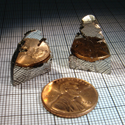

Iron-based superconductors with transition temperatures as high as 55 K have generated a significant tide of interest. Yet considerable sensitivity to synthesis conditions makes the growth of large single crystals for many of these compounds difficult, and this in turn makes crucial experiments either infeasible or hard to interpret.
In a paper appearing in Physical Review B, Brian Sales and David Mandrus of Oak Ridge National Laboratory, and collaborators in the US and Canada, report the successful growth of very large single crystals of . These compounds are a recent addition to the still expanding family of iron-based superconductors, and they exhibit superconducting transition temperatures as high as 14 K at ambient pressure, and up to 27 K under pressure. They consist of alternating layers of iron and , with any excess iron accommodated in the layers. It is interesting to note that the binary compounds and are quite different: the former is superconducting in a narrow range of temperature and composition, but does not form single crystals easily, while the latter does form large single crystals, but superconductivity is absent.
Clear evidence for bulk superconductivity in appears at = 0.5. Obtaining such large single crystals opens the way for experiments that will elucidate the electronic and structural properties and the interplay between them in these materials. – Alex Klironomos