




Powering up Magnetization
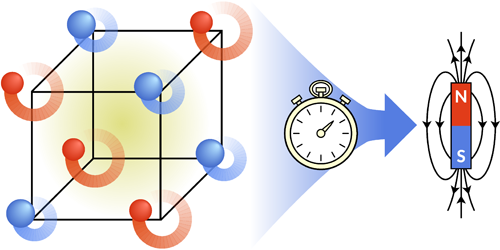

Multiferroics are materials that exhibit both a permanent magnetization (ferromagnetism) and a permanent electric polarization (ferroelectricity). In some cases, the magnetization and polarization are coupled, which could offer novel ways to control devices for spintronics and other applications. A new theoretical work describes a previously uncharacterized case of magnetoelectric coupling, in which a time-varying electric polarization induces a magnetization. This so-called “dynamical multiferroicity” may explain multiple phenomena, including a recent observation of light-driven magnetization.
Magnetic and electric fields are intimately related through Maxwell’s equations. A time-varying electric field in a coil, for example, generates a magnetic field. In certain multiferroic materials, the internal magnetization and polarization bear a similar connection to each other. One known example of this is terbium manganite, for which a spatially varying magnetization produces an electric polarization. Dominik Juraschek, at the Swiss Federal Institute of Technology (ETH) in Zurich, and colleagues showed that a reciprocal effect was possible in which a time-varying polarization produces a magnetization. Microscopically, one can imagine a material’s polarization made up of tiny rotating electric dipoles that, acting like nanoscale coils, generate localized magnetic fields.
This dynamical multiferroicity could explain a recent observation of a magnetization wave (or magnon) induced by terahertz light pulses in erbium ferrite. According to the team’s analysis, these pulses generate lattice oscillations (phonons) that produce the requisite time-varying electric polarization. The team predicts a similar phonon-mediated effect in a highly polarizable, nonmagnetic material, like strontium titanate, placed in a strong magnetic field. The researchers also consider the potential of dynamic engineering, in which one could create novel magnetoelectric states in a material by continuously driving its polarization with terahertz light.
This research is published in Physical Review Materials.
–Michael Schirber
Michael Schirber is a Corresponding Editor for Physics based in Lyon, France.