




Training Africa’s Solar-Energy Labor Force
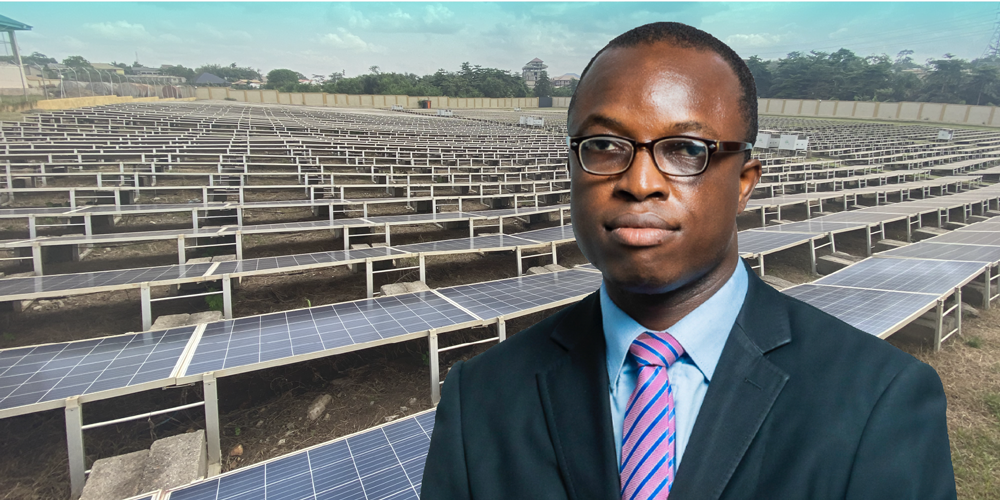

Africa is sunny. The continent holds 40% of the globe’s total solar-energy potential. Yet in 2022, it produced only 1.2% of global solar electricity. Policymakers across Africa and their international partners have set ambitious goals to tap this potential by 2030.
Norbert Edomah, a Nigeria native and professor of energy systems and policy at Nigeria’s Pan-Atlantic University, says a key element for success will be developing effective training—in particular vocational education—for people who will be employed at solar-energy facilities. Given the planned rate of deployment, a large workforce will be needed to maintain the solar infrastructure. Edomah and his collaborators have evaluated the solar industry in Ghana, Nigeria, and Uganda to design solar vocational training programs tailored to local needs [1]. They’ll implement the coursework in a pilot program in the three countries next year.
In an interview with Physics Magazine, Edomah discusses the challenges and opportunities for building solar-energy capacity in Africa.
All interviews are edited for brevity and clarity.
What’s your experience with vocational education?
In the early 2000s, I attended the Institute for Industrial Technology, a private vocational institution in Nigeria. The institute designed its curriculum after surveying manufacturing companies in the country’s southwest. The companies didn’t want technicians with skills in just one trade—such as welding—but people who could work with machines that integrate several technologies.
My course in electromechanics included training in electrical and mechanical systems, electronics, and industrial automation. I used those skills to become a sales engineer who audited the energy needs of multinational food and beverage companies and designed solutions for them.
How did that experience inform your current work on vocational training for solar energy?
Just like the companies I worked for, the solar sector needs technicians with multidisciplinary training. Solar installers need to understand integration with electrical systems, from distribution to power protection. Training people on solar installation alone would not provide them with enough skills to work effectively in this sector.
For your curriculum design study, you toured Ghana, Nigeria, and Uganda. Why did you choose them?
They can offer case studies relevant for different levels of “energy access”—the percentage of people with access to energy—and different levels of electrical-infrastructure development and connectivity.
In Africa, energy access varies in meaning. Ghana reports 90% energy access, which means 90% of the population has electricity available when they need it. Nigeria reports 61% energy access, but that figure refers to how many people are connected to the grid—not how many actually receive reliable power. Outages are frequent, so access doesn’t always translate to availability. Meanwhile Uganda reports 52% energy access.
Energy access also means something different to individuals. In some rural communities in Nigeria, people say that they have energy access if they have firewood. These multiple understandings pose challenges for policy and infrastructure planning.
If Ghana is already so well connected, why do companies or individuals want to adopt solar installations?
In Ghana, the main driver is cost reduction. For example, one small pharmaceutical company built a 1.1-megawatt solar installation that provided up to 70% of the electricity it needed. The solar-produced electricity was at least 35% cheaper than grid energy.
What about the other countries?
In Nigeria, the driver is not only cost but also availability. People with grid access near urban centers, for example, install solar because they know that they will have energy during the day and can plan accordingly.
In Uganda, solar power is often the only option where it’s too expensive to build grid connections. Nongovernmental organizations install solar minigrids to quickly provide access to energy in isolated communities, such as on islands in Lake Victoria and in the mountains.
What’s a solar minigrid?
It’s a collection of solar panels combined with a centralized battery storage system that may or may not be connected to the main grid. Minigrids can produce between 20 and 100 kilowatts of electric power, which they deliver to households via cables as a part of a local distribution system—even at night. Rural communities use them for lighting applications, health centers, or schools. The minigrids also support women running microbusinesses, such as selling sodas around their homes.
Are these minigrids popular elsewhere?
Yes, especially where communities are far apart. In Nigeria, minigrids are mostly found in the rural north where extending the national grid would be expensive. Minigrids have been deployed there quickly with the support of the Rural Electrification Agency of the Nigerian government.
How difficult is it to incorporate new solar vocational education in these countries?
Ghana is strongest when it comes to vocational training. The country’s government has a commissioning arm that develops new curricula at the national level and an implementation arm that enacts the commission’s policies and guidelines.
The commission also has a board that directly gathers industry feedback about skills workers need, which allows the government to quickly adapt vocational curriculum for changing demands. Nigeria and Uganda can’t do this as systematically as Ghana.
What comes next for your curriculum development project?
We just sent 12 teachers from our partner education institutions in Africa to a training program and internship with a vocational education institution in San Sebastian, Spain. Now these teachers have begun teaching pilot programs for multidisciplinary solar training at different vocational training institutions in the three countries. After the program, their students will intern with our partner companies where they will be involved in design, installation, and maintenance of solar systems. We will use feedback from participants to improve the solar training curriculum.
And how could the program help Africa in the near future?
These vocational programs can support solar-expansion initiatives throughout Africa. For example, here in Nigeria, the government’s Solar Power Naija Programme aims to create 5 million new solar-based connections in unserved and underserved communities. A trained workforce will be essential for installing and maintaining that infrastructure.
–Sophia Chen
Sophia Chen is a freelance science writer based in Columbus, Ohio.
References
- N. Edomah, “Drivers of sustainability education and green vocational education and training in Africa’s solar sector: A case study of Nigeria, Ghana, and Uganda,” PRX Energy 4, 043011 (2025).