




Quantum Scars Unmasked
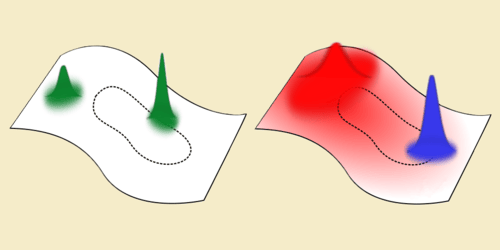

Quantum computers and simulators require systems of interacting particles that can retain quantum coherence for a long time. But the particle interactions tend to make such systems lose coherence quickly. This decoherence can be delayed by engineering and controlling the systems so that their dynamics linger in persistent, preexisting patterns called quantum scars. But for many systems, identifying such patterns in advance has been difficult. Now Jie Ren at the University of Leeds in the UK and his colleagues have demonstrated a general theoretical method for finding these scars [1].
Scars are usually confined to a small region in a system’s state space where each state has low entanglement, a feature that helps maintain coherence. In the new approach, a state in this region is randomly selected and is assumed to have both a generic component and a scar component. The system’s evolution is then simulated for a short time, during which the generic component becomes highly entangled. The evolved state is then “projected” back into the low-entanglement region. This operation is similar to silhouette formation: It retains the state’s potential scar component (its “outline”), while suppressing its highly entangled, generic component (its “interior”). By repeating this evolution–projection process many times for different initial states, any state with a scar component will slowly find its way toward a scar.
The researchers validated their method by recovering known scars for a benchmark model system comprising a chain of interacting spin-1 particles. They then applied their technique to a chain of spin-1/2 atoms, uncovering a previously unknown scar. The new approach could be used to study various other systems because it requires no prior knowledge of a system’s microscopic details, the team members say.
–Ryan Wilkinson
Ryan Wilkinson is a Corresponding Editor for Physics Magazine based in Durham, UK.
References
- J. Ren et al., “ScarFinder: A detector of optimal scar trajectories in quantum many-body dynamics,” PRX Quantum 6, 040332 (2025).