




The Reconstructability of Networks
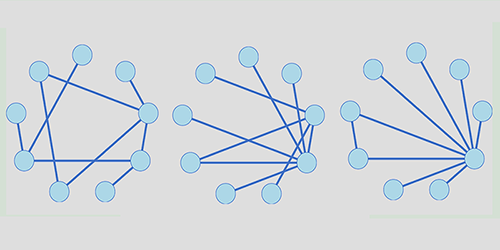

Network models provide a flexible way of representing objects and their multifaceted relationships. Deriving a network entails mapping hidden structures in inevitably noisy data—a critical task known as reconstruction. Now Gang Yan and Jia-Jie Qin of Tongji University in China have provided a mathematical proof showing what makes some networks easier to reconstruct than others [1].
Complex systems in biology, physics, and social sciences tend to involve a vast number of interacting entities. In a network model, these entities are represented by nodes, linked by connections weighted to describe the strength of each interaction. Yan and Qin took an empirical dataset and used a statistical inference method to calculate the likelihood that any pair of nodes is directly linked. Then, based on the true positive and false positive rates of these inferred connections, they analyzed the fidelity of the reconstructed networks. They found that the most faithful reconstructions are obtained with systems for which the number of connections per node varies most widely across the network. Yan and Qin saw the same tendency when they tested their model on synthetic and real networks, including metabolic networks, plant-pollinator webs, and power grids.
With the rapid increase in available data across research areas, network reconstruction has become an important tool for studying complex systems. Yan and Qin say their new result both solves the problem of what complex systems can be easily mapped into a network and provides a solid foundation for developing methods of doing so.
–Rachel Berkowitz
Rachel Berkowitz is a Corresponding Editor for Physics Magazine based in Vancouver, Canada.
References
- J.-J. Qin and G. Yan, “High reconstructability of degree-heterogeneous networks,” Phys. Rev. Lett. 134, 137402 (2025).