




Quantum Dots Emit Photons in Desired Directions
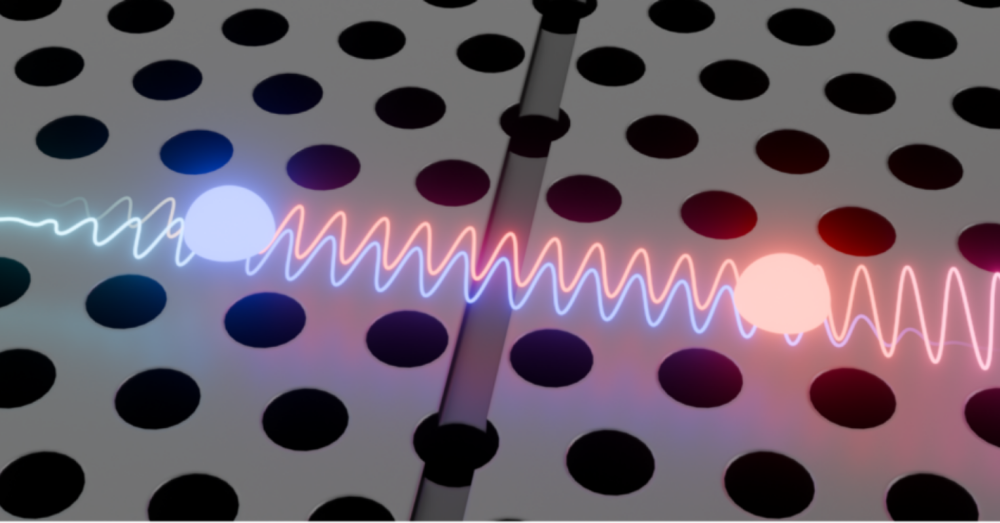

A quantum dot is a small chunk of semiconductor material that emits single photons when excited by light, just as an atom does. By placing two dots in an optical waveguide, researchers have created a “molecule” whose emission direction along the waveguide can be controlled [1]. This directional emission has been observed previously with microwaves, but this experiment is the first to demonstrate such control at optical frequencies. The design could potentially find application as an optical switch in quantum networks.
Single-photon emitters have important uses in quantum networking. A popular choice for an emitter is a quantum dot, which can be excited either electrically or optically. When the dot drops back to its ground state, it releases a photon with a characteristic frequency.
Typically, quantum dots are used individually, but Cornelis van Diepen from the University of Copenhagen in Denmark and his colleagues have been developing methods for coupling pairs of dots. Their goal has been to use this coupling to control the direction of photon emission. “This emission control would be relevant for when you want to build a quantum network and use photons to relay information between nodes,” van Diepen says.
To explore the directional emission of coupled dots, the team grew indium-gallium-arsenide dots on a wafer and then etched a photonic crystal pattern on the top of the wafer. The pattern was an array of holes with one row of holes missing—this row acted as a waveguide, confining photons to move in the plane either to the left or to the right.
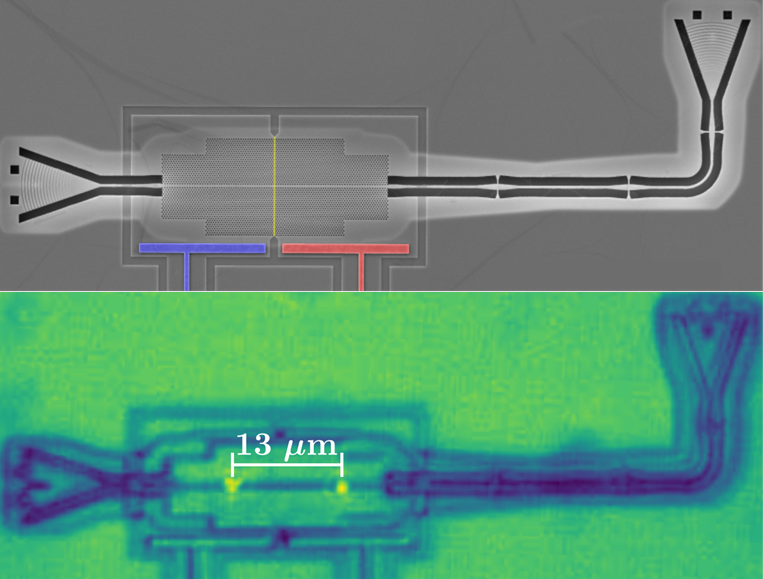
The fabrication process resulted in several dots being arranged within the waveguide. The challenge was that the dots have various sizes, which means that they do not normally emit photons of the same frequency, explains Copenhagen team member Clara Henke. The researchers’ solution was to identify a pair of dots of nearly the same size and then to individually adjust the frequency of each dot. Such tuning was accomplished with tiny electrodes that supplied spatially localized electric fields. This procedure allowed the team to match the frequencies of the dots so that they could interact via photons traveling through the waveguide.
To demonstrate this interaction, the researchers selected a pair of dots separated by 13 μm, which is far compared to the usual distances over which dots interact, van Diepen says. In their first set of experiments, the researchers shined a laser beam on each dot, exciting both. They controlled the phase difference between the two lasers and found that for a certain value, the dot pair emitted photons only to the left. For another value of the phase difference, the emission was only to the right. Using a theoretical model, the team showed that this directionality was the result of quantum interference effects.
In their second set of experiments, the researchers excited only one dot with a laser. At the same time, they adjusted the localized electric fields to slightly detune the frequency of the other dot. They found that they could steer the direction of the emission through these frequency modifications.
These experiments are not the first to show directionality in photon emission, says quantum physicist Yasunobu Nakamura from the University of Tokyo. His research team and others have shown that superconducting qubits can be controlled to emit single microwave photons in a desired direction [2]. However, it would be difficult to use these microwave photons in a quantum network, as they would be overwhelmed by thermal photons. “I am glad to see that [directional emission control] has now been realized in the optical domain by using quantum dots,” Nakamura says. He believes this work could advance efforts to connect distant quantum information nodes in a network.
Stuart Masson, who studies quantum optics at the University of South Florida, says the work is an exciting advance. He says that many quantum information tasks, such as entanglement distribution in quantum networks and light-based quantum-enhanced sensing, require careful control over photon emission. The work of van Diepen and colleagues “highlights the promise of quantum dot waveguide systems as sources of quantum light.”
–Michael Schirber
Michael Schirber is the Deputy Editor of Physics Magazine.
References
- C. Henke et al., “Directional and correlated optical emission from a waveguide-engineered molecule with local control,” PRX Quantum 7, 043032 (2026).
- N. Gheeraert et al., “Programmable directional emitter and receiver of itinerant microwave photons in a waveguide,” Phys. Rev. A 102, 053720 (2020).