




Hawking’s Black Hole Paradox Exposed Clash Between Physics Theories
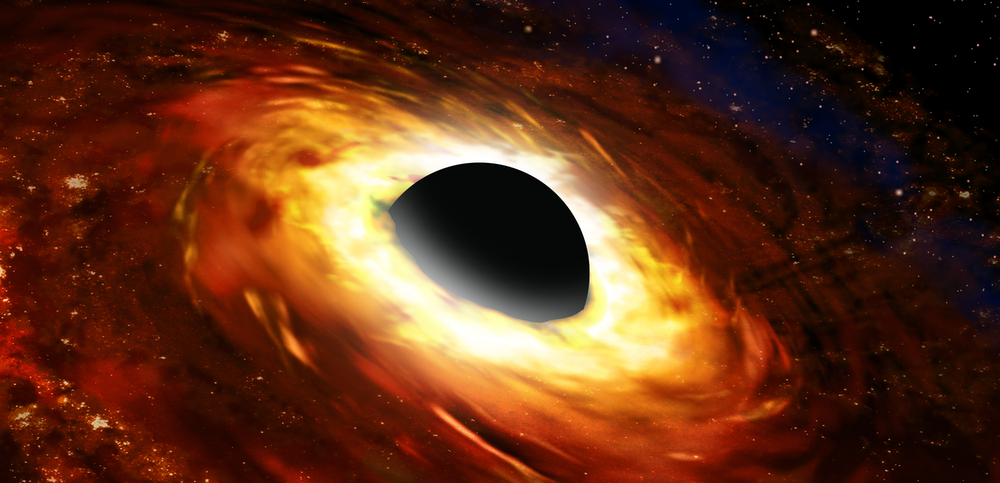

This article is part of a series that Physics Magazine is publishing to mark the 50th anniversary of Hawking’s formulation of the information-loss paradox.
Stephen Hawking’s 1976 paper on a puzzling consequence of the properties of black holes [1] sparked a debate that continues today. The paper pitted the two fundamental theories of modern physics—quantum mechanics and general relativity—against one another, highlighting their apparent incompatibility. Although that tension was already known, Hawking identified a concrete scenario in which the two theories could be brought together and their conflict explored. At the heart of the matter is a deceptively simple question: Can information ever be wholly erased from our Universe?
The idea of black holes as real astrophysical objects had become accepted only in the 1960s. Hawking arrived at the “information paradox” as a consequence of his previous groundbreaking paper showing that black holes are not wholly dark but emit radiation, which leads to their slow evaporation. This evaporation seemed to imply that any information contained within a black hole—carried into the interior by infalling debris—would disappear. The information loss comes out of a general relativistic framework, but it is forbidden by quantum mechanics. This conflict between theories was at the core of his 1976 publication [1].
An Outstanding Mind
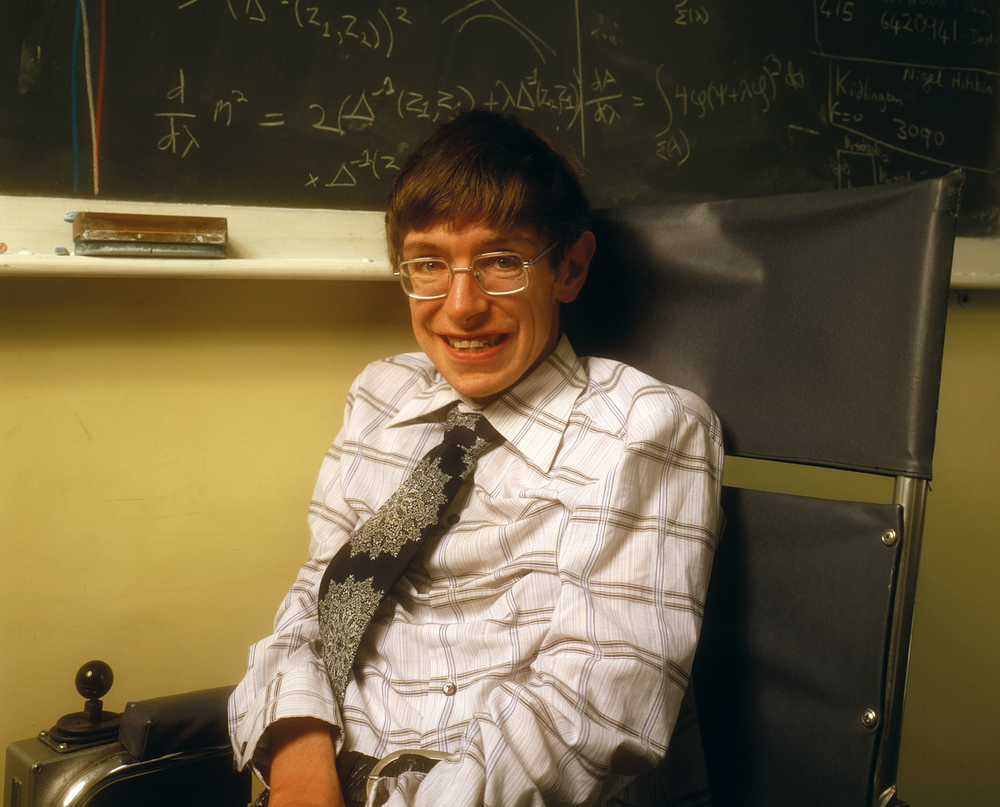
At that time, Hawking was at the height of his scientific powers, even while his physical faculties were declining rapidly. He had been diagnosed in 1963 with ALS. The disease, which is currently incurable, produces a gradual loss of muscle control and is ultimately fatal. When his condition was recognized, Hawking had just turned 21 years old and was in the early stages of his PhD research at the University of Cambridge in the UK. Physicians did not expect him to live more than ten years longer.
Hawking had previously been a very gifted but somewhat lazy undergraduate student of physics at the University of Oxford, but the prognosis ultimately seemed to transform him into an intensely ambitious doctoral student. Cosmologist George Ellis of the University of Cape Town in South Africa, who later worked closely with Hawking, recalls a 1964 public lecture by eminent cosmologist Fred Hoyle at which the young Hawking declared Hoyle’s theory incorrect. This assessment was based on Hawking’s own study of the theory. “It was my first realization that Stephen had a truly outstanding mind, not just a fine one,” Ellis says.
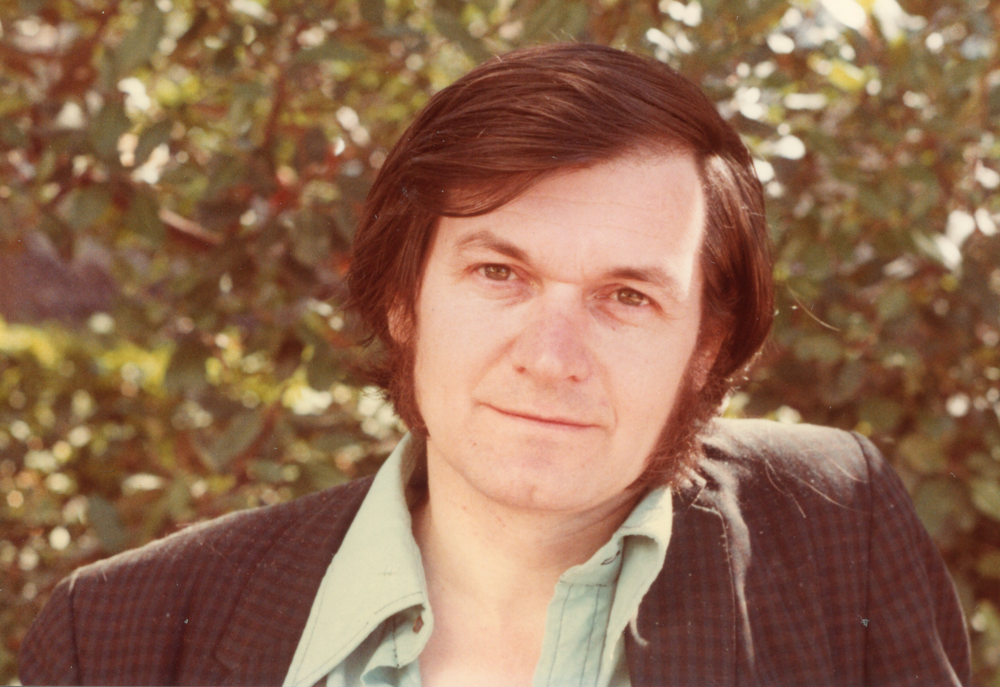
Hawking’s work on black holes built on that by mathematical physicist Roger Penrose. In 1965, working at Birkbeck College, University of London, Penrose used general relativity to examine the fate of a star that has exhausted its nuclear fusion fuel. In work that eventually won him a Nobel prize, he found that, contrary to the views of many experts, if the star were sufficiently massive, it could collapse under its own gravitational field in a runaway process (see Nobel Prize: Facing the Reality of Black Holes) [2]. Penrose showed that this process would lead eventually to a “singularity” in which all the mass would be crushed into a space of zero volume and infinite density. The resulting gravitational field around the collapsed star would be so intense that not even light could escape from within it. Anything within the event horizon—a spherical shell marking the point of no return—would be effectively removed forever from the rest of the Universe.
The possibility of black holes had been apparent to Einstein after he unveiled general relativity in 1916 (though the catchy name came in the 1960s). But most physicists thought that the singularity was merely a mathematical quirk, not something that could be seen in the real world. The problem was that any deviation of the star’s shape from perfectly spherical, or any rotation of the star, was believed to destabilize the collapse and halt the progress toward a singularity. That idea was qualitative, however, and when Penrose actually performed the challenging general-relativistic calculations for stellar collapse, he found that the formation of a black hole did not depend on maintaining perfect spherical symmetry but was the likely end point for any heavy star.
Black Holes Get Lighter
In 1965—the final year of his PhD course—Hawking applied Penrose’s methods to the entire Universe and showed that they predicted a kind of gravitational collapse in reverse: expansion from a singularity. In other words, general relativity supplied an origin of the Universe in what Hoyle had rather dismissively called a “big bang.” That cosmological model had already been proposed and seemingly confirmed the previous year by the discovery of the cosmic microwave background radiation that the model predicted. But there had not previously been a theory that included the big bang’s starting point—and Hawking showed that a singularity fit the bill.
After receiving his PhD, Hawking remained at Cambridge and continued to work on black holes. In 1973 he visited Moscow and met with the leading Soviet expert on general relativity, Yakov Zel’dovich. There he heard from his host that Zel’dovich’s student Alexei Starobinsky had performed calculations predicting that a rotating black hole would emit radiation.
Hawking was skeptical, but after he redid the calculations using his own methods, he found that not only were the Soviet scientists right but that, for reasons they had not appreciated, black hole radiation was a very general phenomenon not confined to those that rotated. Black holes, as Hawking later put it, “ain’t so black.”
The discovery seemed to resolve an earlier puzzle. In the early 1970s, Jacob Bekenstein, then a graduate student of John Wheeler at Princeton University, proposed that a black hole possesses an entropy proportional to the surface area of its event horizon. The problem, as Hawking argued in 1972, is that any object with an entropy must also have a temperature—and must therefore emit radiation. How could that be, if nothing escapes from the event horizon?
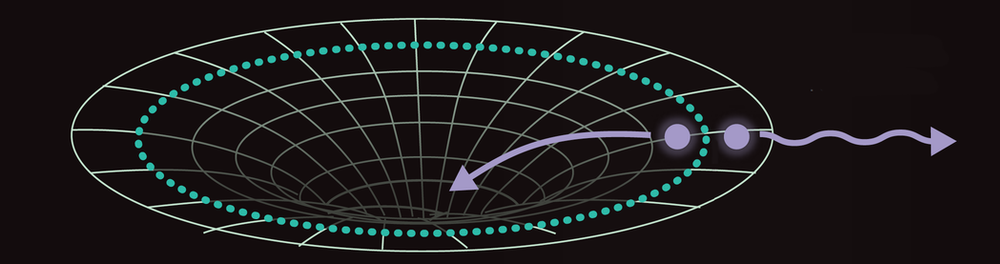
Hawking argued that the radiation can be understood as arising from the influence of quantum fluctuations in the vacuum close to but outside the event horizon. He offered an intuitive picture of the process. Quantum field theory predicts that this vacuum constantly generates pairs of virtual particles, such as electron–positron pairs and photons. Usually, they exist for only a brief instant. But if one particle from a pair is drawn beyond the event horizon before it has a chance to interact with its partner, the partner then becomes a real particle that seems to have been emitted from the black hole.
According to quantum field theory, the infalling particle has negative energy, so it reduces the black hole’s mass. Such an influx of particles will therefore cause the black hole to gradually shrink (once it runs out of nearby matter to absorb). Hawking predicted that when the mass falls below a certain very small threshold, a black hole will explode and vanish. Although this will take an enormously long time—far longer than the age of the Universe—the implication seemed clear: The radiation emitted from black holes will cause them to evaporate. He published his results in a 1974 paper titled “Black hole explosions?” [3], which introduced the idea of what became known as Hawking radiation.
“That paper for the first time married together relativity theory, quantum theory, and thermodynamics,” says astrophysicist Bernard Carr of Queen Mary University of London, who was studying for a PhD under Hawking’s supervision at Cambridge at that time. “That’s what made it one of the most important physics results in the second half of the 20th century.”
While quantum mechanics seems to impose a finite granularity on the fabric of the Universe, general relativity represents spacetime as smooth and continuous and seems to permit infinitely small objects like singularities. Hawking’s work didn’t exactly reconcile these apparently conflicting theories, as his treatment of quantum effects was approximate and “semiclassical.” But it opened up a way to talk about both theories in the same breath.
“I remember John Wheeler telling me, ‘This is such a beautiful result. It’s like rolling candy on the tongue,’” Carr says. Although Hawking’s conclusion that black holes radiate went against all expectation, Carr adds, “it was such a beautiful result that within a few years almost everybody accepted it.”
The prediction has yet to be verified empirically, however. There is now definitive evidence of black holes, but Hawking radiation would be far dimmer than the intense radiation produced by the hot disks of infalling matter that surround many black holes—and even fainter than the cosmic microwave background. Hawking was disappointed that, in his view, this lack of observational support for his idea prevented the Nobel committee from awarding him a prize. “There may never be any direct evidence,” Carr admits.
A Vanishing Trick
Evaporating or exploding black holes posed a puzzle. According to quantum mechanics, the information describing the quantum state of an object evolves in time but cannot disappear—a consequence of a core quantum principle called unitarity. Information is in some sense imprinted in all matter that falls into a black hole—for example, information about the positions of the atoms—but once beyond the event horizon, that information seems to be lost to our accessible Universe. With its perfectly featureless event horizon, a black hole is a simple object, according to general relativity. It’s completely characterized by its mass, charge, and spin (angular momentum), somewhat like an electron, which also has only a few properties.
This apparent loss of information from the region outside a black hole didn’t seem to be a problem if we imagined that it was somehow preserved inside. But if a black hole could vanish, where did the information go? It could not be carried away by the Hawking radiation, since, according to Hawking’s calculations, this radiation should be thermal and random. As long as black holes looked eternal, says Carr, “we didn’t have to worry about the question of what happened to the information. Once they were shown to be not eternal and that they could evaporate, there was no avoiding that question.”
This information paradox for black holes was what Hawking identified in his 1976 paper [1]. He expressed the problem as a “breakdown of predictability,” whereby one can’t use observations of the black hole (including its Hawking radiation) to fully determine its history—for example, exactly what fell into it. There is, says Carr, “a new level of uncertainty” beyond that familiar in quantum theory. As Hawking quipped in allusion to the famous remark of Einstein, “God not only throws dice, but he throws them where they can’t be seen.” Carr recalls that “a lot of the physicists were unhappy with that.”
An Enduring Puzzle
Although most physicists still consider the paradox unresolved, the paper remains a classic. “That paper is like a Beethoven symphony,” says theoretical physicist Daniel Harlow of MIT. “Most of us would be happy to write one paper that was a tenth as good as that in our whole career.”
The essence of the paper, Harlow says, is best expressed not as a conflict between general relativity and quantum mechanics, but between three principles that physicists hold sacred: unitarity, locality, and the validity of statistical mechanics. The unitarity of quantum mechanics forbids information loss, locality means that nothing inside the event horizon can influence anything outside, and statistical mechanics dictates the relationship between black hole entropy and surface area. In effect, Hawking showed that not all these three things can be true. But which one gives way? That’s the consideration behind all efforts to resolve the information paradox today—and there’s still no consensus about the answer.
“What was so valuable about the 1976 paper was that it led to this amazing discussion that went on for 50 years,” Carr says. “There are all sorts of theoretical developments that have come out of the information paradox. So some people would argue that Hawking’s 1976 paper was in a certain sense even more valuable and productive than the 1974 paper.” He adds, “I think that the resolution of [the paradox] will really only come with the final theory of physics,” meaning a quantum theory of gravity.
–Philip Ball
Philip Ball is a freelance science writer in London. His next book, The Man Who Broke Reality, a biography of Niels Bohr, will be published in December.
References
- S. W. Hawking, “Breakdown of predictability in gravitational collapse,” Phys. Rev. D 14, 2460 (1976).
- R. Penrose, “Gravitational collapse and space-time singularities,” Phys. Rev. Lett. 14, 57 (1965).
- S. W. Hawking, “Black hole explosions?” Nature 248, 30 (1974).