




Galaxy Survey Completes Its Map of the Cosmos
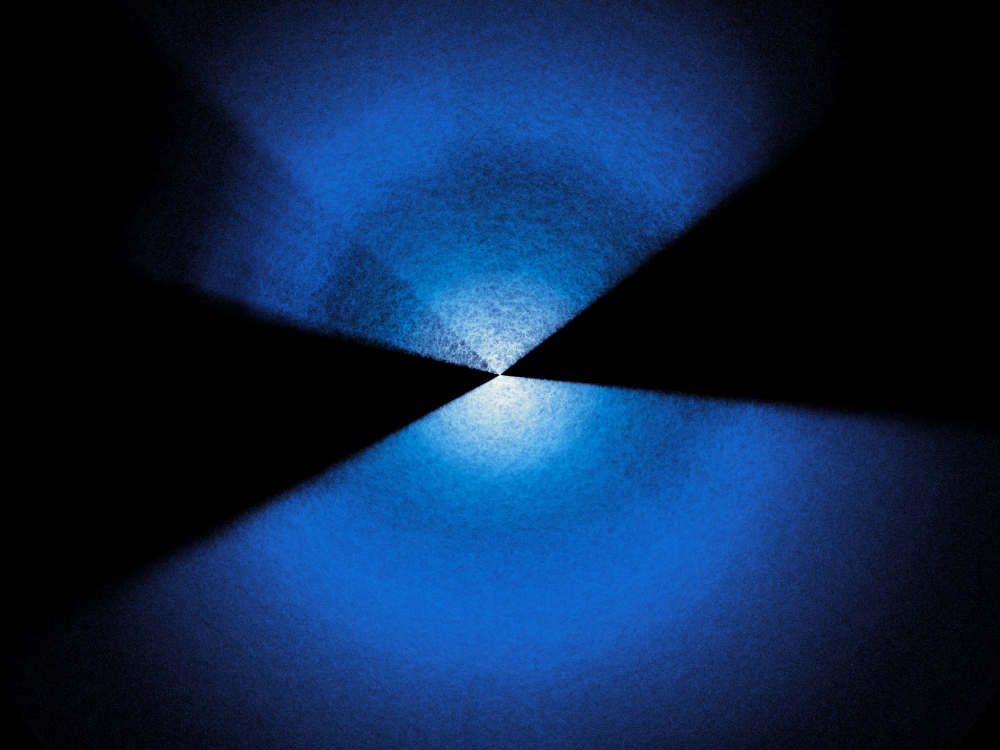

A few weeks before the end of its planned five-year run, the largest-ever high-resolution galaxy survey has concluded with a surplus of observations. The Dark Energy Spectroscopic Instrument (DESI) scanned its last planned region of sky during the wee hours last night, having recorded 47 million galaxies and quasars—13 million more objects than projected. To mark this milestone, the collaboration has released a blue-bespeckled map of the surrounding Universe.
Housed in the Nicholas U. Mayall Telescope atop Kitt Peak in Arizona, DESI began its five-year galaxy survey in May 2021. The instrument uses robotic positioners to align optical fibers with the incoming light from selected objects (see video). The spectrum from each object is analyzed to determine a frequency offset, or “redshift,” from which the distance to the target can be estimated. By combining the data, researchers can construct a 3D map of the Universe (See News Feature: Entering a New Era of Dark Energy Cosmology ).
This 3D-mapping strategy has been employed in other projects, such as the Sloan Digital Sky Survey (SDSS) that began in 2000. DESI, however, collects data much faster than previous instruments, acquiring the redshifts of 5000 objects every 20 minutes. “In one year of DESI data, we measured 3 times more redshifts than in 20 years of SDSS,” says Pauline Zarrouk, a DESI team member at Sorbonne University in France. The survey filled in the cosmic map of galaxies at a faster rate than predicted, thanks to better-than-expected instrument performance and clearer-than-hoped skies. “We were lucky with the weather, especially at the beginning of the survey,” Zarrouk says.
After the release of its first three years of data, the collaboration reported hints that dark energy might be evolving over time (see Viewpoint: Rethinking Our Place in the Universe). Such evolution would run counter to the standard model of cosmology, which assumes that dark energy is a constant. The full five-year dataset should help clear up this debate, with the first cosmological analysis of the observations expected in 2027. “We’re all curious about what surprises are waiting for us,” said DESI Director Michael Levi of the Lawrence Berkeley National Laboratory in California in a press release.
Having completed its main target survey, the collaboration will continue collecting data up through 2028 to extend the project beyond its original scope. The plan is to expand the sky coverage by about 20%, from 14,000 square degrees to 17,000 square degrees. Zarrouk says one of the goals of this extension is to observe parts of the sky that will overlap with galaxy surveys planned for the Vera C. Rubin Observatory in Chile.
–Michael Schirber
Michael Schirber is a Corresponding Editor for Physics Magazine based in Lyon, France.