




Science of Slosh
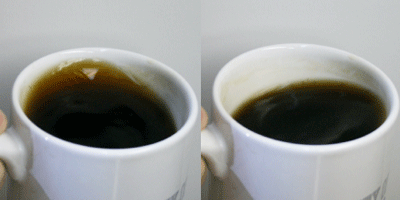

Each morning, blurry-eyed physicists try to solve a frustratingly complex mechanical problem: how to walk with a full cup of coffee, without letting it slosh over the sides. Writing in Physical Review E, Hans Mayer and Rouslan Krechetnikov at the University of California, Santa Barbara, report their study of the biomechanics of walking with coffee and the factors that lead to spills.
The sloshing of liquid in a cylindrical container, like a mug, is similar to the motion of a pendulum: the natural frequencies of oscillation depend on the liquid’s height and diameter (and, of course, gravity). In a typical mug, cm in diameter and cm tall, the lowest frequency oscillation of the coffee rocking back and forth in the cup is easily excited by walking at a normal pace.
This gives an intuitive explanation of why coffee spills, but Mayer and Krechetnikov have found that noise—potentially caused by uneven steps or small jerks of the cup — plays an important role in amplifying the natural oscillations of coffee into a full-blown spill. They set up an image analysis program to track coffee levels in cups carried by human subjects, who were asked to either focus on keeping the coffee from spilling, or to walk without paying attention.
Staying focused makes it less likely a walker will spill his coffee, but Mayer and Krechetnikiv are still testing if this is because the vigilant coffee carrier acts as feedback control that is activated at the first signs of coffee tipping toward the rim. – Jessica Thomas