




Amber Does Not Act Its Age
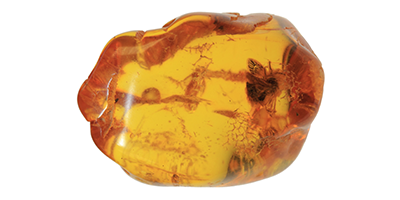

Amber is a vitrified resin valued for its beauty and the intriguing specimens occasionally trapped within it. Now, scientists are studying ancient amber samples to determine how their glasslike properties change with time. Amber is a unique example of a glass because it has “hyperaged,” i.e., has undergone thermodynamic stabilization for millions of years—a process that is impossible to replicate in a lab.
Conventional, nonhyperaged glasses characteristically exhibit a so-called boson peak—an enhancement in the density of vibrational states over that expected for a crystalline solid. As reported in Physical Review Letters, Miguel Ramos at the Autonomous University of Madrid, Spain, and his collaborators used -million-year-old Spanish amber samples to investigate how the boson peak changes as the amber samples are subjected to thermal annealing, which effectively de-ages them. Previous studies suggested that the strength of the boson peak diminished with annealing, although the samples that were tested had only cooled for moderately short laboratory time scales.
Ramos and his team measured the specific heat of several amber samples, comparing specimens of pristine hyperaged amber, samples that had been annealed at temperatures below and around their glass transition temperature, and “rejuvenated” amber that had been heated well above its glass transition temperature. The annealed samples represented glasses with partially erased thermal histories, while the rejuvenated amber had had its -million-year cooling cycle effectively erased. The authors found that the specific heats of all the samples were identical within the experimental errors for temperatures below kelvin. This finding implies that the boson peak and other thermodynamic properties remain fossilized in the glass—much like a trapped insect—and are unchanged by more than million years of aging. – Katherine Kornei