




Testing for Black Hole “Bumps”
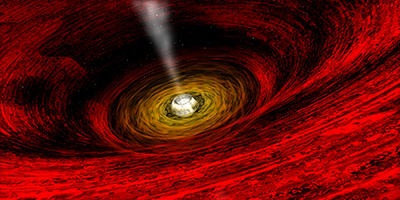

Just before being gobbled up by a black hole, in-falling matter may emit an x-ray signal that could tell us about the black hole’s gravitational field. That’s the assumption of a new theoretical study of matter-accretion disks that form around black holes. The researchers show that alternative gravity models—characterized by “bumps” in the spacetime fabric around the black hole—produce slightly different x-ray emission from the disks. But identifying this signal will be challenging.
Our current understanding of black holes is based on general relativity—a theory that is well tested under relatively weak gravity conditions. However, it’s unclear whether general relativity holds when gravity becomes strong, like around a black hole. Alternative models exist that predict a spacetime in the vicinity of a black hole that differs considerably from that of general relativity.
Christopher Moore and Jonathan Gair of the Institute of Astronomy in Cambridge, UK, propose a way of systematically searching for a possible breakdown of general relativity. Collisions between gas particles in a black hole’s accretion disk cause the gas to heat up and emit x rays. Observations of these x rays have detected distinct emission lines that are shaped by the strong gravity environment from which they arise. Moore and Gair explored whether this x-ray light could act as a probe of the gravity around the black hole. They computed the expected emission around different types of “bumpy black holes,” where the bumps are deviations in the spacetime fabric compared to general relativity. They found that in most cases the effect of a bump on the emission is too small to be observed, but for certain models the signal could potentially be detected.
This research is published in Physical Review D.
–Michael Schirber