




A Riemann calculator?

Perhaps the greatest unsolved problem in mathematics is the Riemann hypothesis, which states that the nontrivial zeros of the zeta function all have a real part equal to 1/2. Many results in mathematics, through their relation to the distribution of prime numbers, are based on whether the hypothesis is correct.
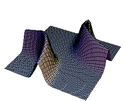
One possible route to a proof of the hypothesis is to find a quantum mechanical system whose quantized energy levels yield the nontrivial zeros of the zeta function. About a decade ago, it was conjectured that the correct quantum system is related to a particular classical system that exhibits chaotic dynamics. Writing in Physical Review Letters, Germán Sierra from CSIC-UAM in Spain and Paul Townsend from the University of Cambridge extend part of this classical model to a realistic quantum mechanical system: a charged particle moving in a plane in a uniform magnetic field and a saddle-shaped electric potential. Although it is not a proof of the Riemann hypothesis, Sierra and Townsend’s idea makes an interesting connection between a physical system—similar to the one in which the quantum Hall effect was measured—and efforts to solve a long-standing mathematical problem. – Sonja Grondalski