




The Trouble with Smooth Edges
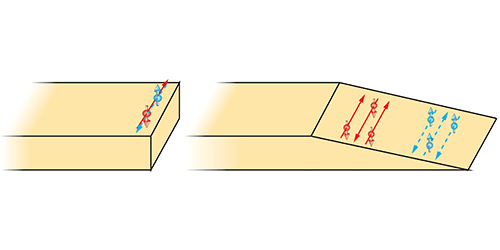
A selling point of topological insulators is that their electrons can travel without scattering backwards, a potential plus for high-speed electronics. Theoretically, this backscattering protection exists whether the material is cut into a circle or a square, or even if it’s covered in gunk. However, theorists in Israel have found that a seemingly innocuous change—beveling the material’s edges—could tamper with the backscattering immunity.
Jianhui Wang and Yigal Meir, of Ben-Gurion University of the Negev, and Yuval Gefen, of the Weizmann Institute of Science, studied two-dimensional insulators that exhibit a quantum spin-Hall phase. In this topological phase, electrons move in a single “lane” along the material edges, with electrons of one spin cycling clockwise, and electrons of the opposite spin traveling counterclockwise. Moreover, edge electrons cycling in one direction can’t backscatter into the other direction. Using models that predict this phase, the team calculated the edge states of insulators with sharp edges (the positive charge from ions in the crystal drops abruptly to zero) and of insulators with beveled edges (the drop is more gradual), which are more realistic than sharp edges. They found that if the drop is too gradual, electrons of different spin states separate into two distinct lanes. This effect equates to breaking time-reversal symmetry, the property that prevents backscattering.
What are the implications for experiments? For one, more backscattering means a poorer conductor. On the flip side, there might be a benefit to having edge states with a single spin: one could shape the edges of two topological insulators such that a point contact between them selects for a particular spin, a useful trick for spintronics.
This research is published in Physical Review Letters.
–Jessica Thomas
Jessica Thomas is the Editor of Physics.