




Odd and Even Effects Uncovered in Graphene
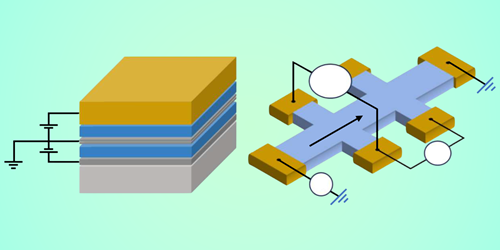

In a nonlinear Hall effect (NLHE), an electric field applied in the plane of a material induces a transverse voltage that depends nonlinearly on the field. This voltage can scale with either an odd or an even power of the electric field, but the conditions governing these two types of responses have been poorly understood until now. Luojun Du of the Chinese Academy of Sciences and his colleagues have demonstrated and explored such odd- and even-order NLHEs in a bilayer-graphene system [1]. Their findings could help scientists develop more efficient rectifiers and other electronic devices.
Bilayer graphene possesses inversion and vertical mirror symmetries, either of which must be broken before an NLHE can appear. The researchers observed that the even-order NLHEs required the application of an additional, out-of-plane electric field to break inversion symmetry. By contrast, the odd-order NLHEs required the application of an out-of-plane magnetic field to break vertical mirror symmetry. These results show that the two types of NLHEs are governed by different symmetry conditions and can be effectively driven by either an electric or a magnetic field.
Du and his colleagues also found that, upon applying an out-of-plane magnetic field, the even-order NLHEs had a contribution to the Hall voltage that increased linearly with magnetic-field strength. By contrast, the odd-order NLHEs had a contribution dominated by a surprising cubic scaling in magnetic-field strength. This cubic scaling represents a hitherto unreported and unexplored effect. Overall, the team’s experiments demonstrate how NLHEs can be used to probe the interplay between symmetry breaking and a material’s electronic properties.
–Ryan Wilkinson
Ryan Wilkinson is a Corresponding Editor for Physics Magazine based in Durham, UK
References
- Z. Pan et al., “Odd-even parity of nonlinear Hall effects in bilayer graphene,” Phys. Rev. Lett. 137, 186302 (2026).