




Exposing Majorana Impostors
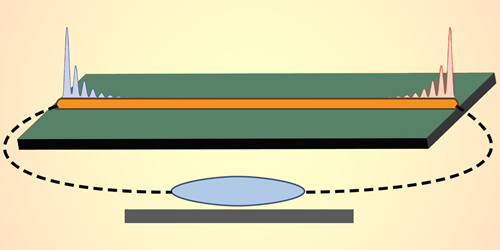

Exotic quasiparticles called Majorana zero modes (MZMs) are highly sought after. One main reason is that they could serve as building blocks of quantum computers that are much less error prone than today’s devices. But it is hard to verify whether a given system hosts MZMs because other phenomena can mimic their signals. Now Binayyak Roy at Clemson University in South Carolina and his colleagues have shown theoretically that quantum inductance—how a system’s energy levels respond to changes in magnetic flux—could help researchers identify true MZMs [1].
A promising platform for generating MZMs has a semiconducting nanowire in proximity to a superconductor, with the wire’s ends coupled to a semiconducting nanostructure known as a quantum dot. The wire and dot form a loop threaded by magnetic flux. A key signature of MZMs is a topologically protected switching of the wire’s fermion parity—whether its total number of electrons is even or odd—as the magnetic flux is varied. This parity switching can be observed by tracking the system’s quantum capacitance—how its energy levels respond to changes in voltage. But inevitable disorder in the wire can generate similar capacitance signals, leading to false positives for MZMs.
Using analytical models and microscopic simulations, the researchers found that the MZM-induced parity switching results in a crossing at a characteristic magnetic-flux value in plots of the system’s quantum inductance versus the flux. By contrast, disorder leads to localized pronounced peaks and dips in such plots. Given this difference, the researchers suggest that combined capacitance and inductance monitoring offers a robust, experimentally accessible way to identify MZMs in these systems. This strategy could be implemented using existing measurement techniques, the team says.
–Ryan Wilkinson
Ryan Wilkinson is a Corresponding Editor for Physics Magazine based in Durham, UK.
References
- B. B. Roy et al., “Quantum inductance as a phase-sensitive probe of fermion parity switching in Majorana nanowires,” Phys. Rev. B 114, 295406 (2026).