




The Gurzhi Effect Reaches Three Dimensions
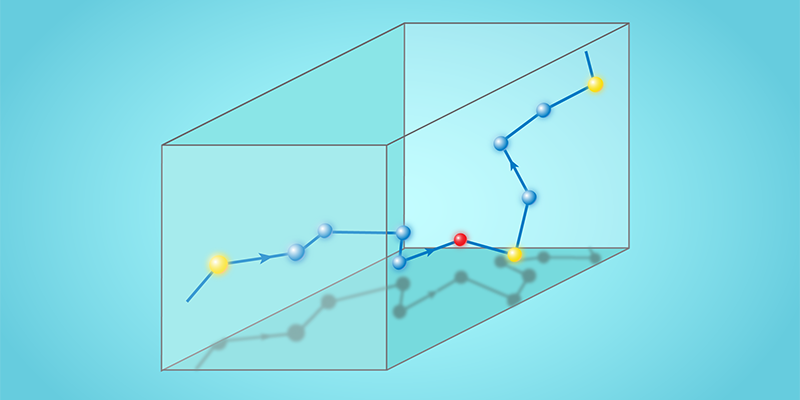

In an ordinary metal, electrons undergo collisions with impurities, phonons (lattice vibrations), and material boundaries. By removing momentum from the electrons, these collisions determine the metal’s conductivity. One of these types of collisions—between electrons and phonons—becomes more frequent at high temperatures, further impeding the electron flow and decreasing the metal’s conductivity as it warms. But more than 60 years ago, the physicist Radii Gurzhi predicted that, under certain circumstances, some metals might behave more like classical liquids, in which thermal energy reduces the fluid’s internal resistance to flow, or viscosity, causing conductivity to increase with temperature [1]. Despite having been studied theoretically for decades, the so-called Gurzhi effect was only recently confirmed in graphene [2], following tentative observations in potassium [3]. Now a team led by Kamran Behnia of ESPCI Paris and Zengwei Zhu of Huazhong University of Science and Technology in China has shown that the resistivity of a 3D elemental metal varies with both sample size and temperature as predicted by Gurzhi’s theory [4].
A device’s electron-transport regime is determined by its physical dimensions and by a competition between two different scattering mechanisms: momentum-relaxing collisions (with impurities or phonons), which decrease the total momentum of the electrons, and momentum-conserving collisions (between electrons), which merely exchange momentum among the electrons. When momentum-relaxing collisions dominate and the resulting electron mean free path is much smaller than the device width, transport is diffusive. When those momentum-relaxing collisions are less common, or if the device is very narrow, the mean free path is set by the device width, and transport is ballistic. An intermediate hydrodynamic regime occurs when momentum-conserving collisions are dominant, meaning that electrons collide with one another many times before losing momentum to the boundaries of the device or to other momentum-relaxing collisions (Fig. 1). In this regime, the electron fluid develops a parabolic velocity profile across the device’s width, resulting in a conductivity that scales quadratically with width. The fluid’s resistance to flow—its viscosity—is set by the interval between electron–electron collisions, which in a Fermi liquid is inversely proportional to T2/EF (where T is the temperature and EF is the Fermi energy) [5]. Warming the fluid or reducing EF increases the collision frequency and lowers its viscosity, causing conductivity to scale quadratically with temperature—the signature of the Gurzhi effect.
Achieving this hydrodynamic regime experimentally is a challenge. The sample’s temperature must be sufficiently low that momentum relaxation from phonons is suppressed yet high enough that the scattering between electrons dominates over temperature-independent impurity scattering. But even when electron–electron scattering is dominant, momentum-conserving collisions are not the only collisions whose rates scale quadratically with temperature. At high enough energies, electron–electron interactions start to deposit momentum in the crystal lattice. The increasing occurrence of these so-called umklapp events means that electron–electron scattering typically causes the resistivity (rather than conductivity) to grow with the square of the temperature. In graphene, umklapp scattering is suppressed owing to the material’s electronic structure and in particular its Fermi energy—that is, the electrons’ maximum energy at low temperature. At a few tens of milli-electron-volts, doped graphene’s small Fermi energy (relative to the temperature) enhances the momentum-conserving scattering rate. It has remained an open question whether the hydrodynamic regime can be hosted by an ordinary 3D metal with a Fermi energy on the order of 1 eV.
Behnia, Zhu, and their colleagues addressed this question by studying high-purity crystals of hexagonal close-packed cadmium. They used focused-ion-beam etching to prepare a series of samples whose effective size (the geometric mean of the width and thickness) ranged from about 2 to 114 µm. Thanks to this technique, they could shrink the samples without introducing new defects, ensuring that the rate of momentum-relaxing collisions due to lattice disorder would remain unchanged as the size was varied. The largest sample behaved as an ordinary metal, with a resistivity that decreased quadratically in temperature toward a constant residual value as the sample was cooled. However, samples of about 65 µm and smaller exhibited the Gurzhi effect, with the resistivity reaching a minimum near 5 K, then rising upon further cooling.
Because boundary scattering strongly affects electrical resistance in small samples, Behnia, Zhu, and colleagues needed to quantify it to isolate the hydrodynamic effect. For thin films, the resistivity due to boundary scattering is known to scale inversely with the thickness [6]. The researchers obtained the size-dependent residual resistivity by fitting this model at 5 K, where hydrodynamic contributions are taken to be negligible, and extrapolating the results to zero temperature. Subtracting this residual resistivity, they found that the hydrodynamic contribution to the conductivity grew as the square of both the temperature and the sample size. Below about 2.5 K, the smaller samples deviated from this scaling as the momentum-conserving mean free path became comparable to the sample size, marking the onset of the ballistic regime.
The researchers compared the resistivity’s quadratic dependence on temperature of the thickest sample (which is controlled largely by collisions with impurities, defects, and phonons) to the conductivity’s quadratic dependence on temperature of the thinner samples (controlled largely by collisions with boundaries, which are mitigated by electron–electron collisions). The comparison revealed that the momentum-relaxing mean free path was several hundred times longer than the momentum-conserving mean free path. This dominance of momentum-conserving collisions is a necessary condition for the emergence of the Gurzhi effect. But how can the effect be compatible with this metal’s relatively large Fermi energy?
Hexagonal close-packed cadmium’s primary charge carriers reside in three main regions or “pockets” of its Fermi surface—two hole-like pockets and one electron-like pocket. Given that all these pockets have Fermi energies on the order of 1 eV, consistent with the extracted momentum-relaxing lifetime, the researchers argue that the much shorter momentum-conserving lifetime must be associated with some smaller energy scale. Through an ab initio calculation of the band structure, they found additional small pockets with Fermi energies as low as 0.5 meV. From a coarse scaling of the collision rate with Fermi energy, Behnia, Zhu, and colleagues propose that these additional pockets determine the momentum-conserving collision rate at temperatures where the momentum-relaxing mean free path exceeds the sample size. If their conclusion holds, and materials with multiple Fermi surfaces exhibit a hierarchy of scattering rates in which momentum-conserving collisions remain dominant at low temperature, the study could guide ab initio searches for other hydrodynamic materials.
There are, however, complications that must be considered. As Behnia, Zhu, and colleagues point out, the smallest pockets lie close to the much larger hole-like pockets, so scattering of electrons between pockets may be as relevant as the small Fermi energies in setting the momentum-conserving lifetime. The geometry of the Fermi surface is also sufficiently complicated that collision rates may deviate from those expected for an isotropic Fermi liquid [7]. In addition, the smallest calculated Fermi energy lies at the limit of the accuracy of the band structure calculation. Further theoretical work is therefore needed to determine which of these mechanisms sets the momentum-conserving lifetime. A full calculation of the collision operator using the researchers’ ab initio band structure, as has been done for strontium ruthenate [8]—another 3D metal with a complex, multiband electronic structure—would disentangle these effects and give a more complete hierarchy of the relevant scattering rates. Understanding the band-structure features that lead to hydrodynamic effects may also pave the way for new low-power electronics by taking advantage of the Gurzhi effect in micrometer-scale devices.
References
- R. Gurzhi, “Minimum of resistance in impurity-free conductors,” Sov. Phys. JETP 17, 521 (1963).
- R. K. Kumar et al., “Superballistic flow of viscous electron fluid through graphene constrictions,” Nat. Phys. 13, 1182 (2017).
- Z.-Z. Yu et al., “Negative temperature derivative of resistivity in thin potassium samples: The Gurzhi effect?” Phys. Rev. Lett. 52, 368 (1984).
- X. Guo et al., “Hydrodynamics of the viscous electron fluid in cadmium,” Phys. Rev. Lett. 137, 206301 (2026).
- P. S. Alekseev, “Negative magnetoresistance in viscous flow of two-dimensional electrons,” Phys. Rev. Lett. 117, 166601 (2016).
- K. Fuchs, “The conductivity of thin metallic films according to the electron theory of metals,” Math. Proc. Camb. Phil. Soc. 34, 100 (1938).
- C. Q. Cook and A. Lucas, “Electron hydrodynamics with a polygonal Fermi surface,” Phys. Rev. B 99, 235148 (2019).
- D. Thuillier et al., “Multipolar fermi surface deformations in Sr2RuO4 probed by resistivity and sound attenuation: A window into electron viscosity and the collision operator,” Phys. Rev. Lett. 135, 146302 (2025).