




Atomic Wave Simulates Black Hole Properties

According to theory, if a pair of mirrors facing one another is vibrated rapidly enough, the optical field between them will display black-hole-like traits, such as the equivalent of an event horizon. These conditions have not yet been realized in the lab, but now researchers have managed something similar by swapping the roles of light and matter [1]. They used sheets of light to reflect waves of ultracold atoms back and forth, creating what they call a matter-wave cavity. Vibrating the sheets of light allows them to simulate the behavior of light propagating close to a black hole, while their setup could also enable the study of many other exotic phenomena.
An optical cavity, which is formed by a pair of mirrors facing one another, offers a versatile tool for manipulating light. Vibrating one of the mirrors causes the length of the cavity to oscillate, which can alter the light’s properties. If the mirror could be made to oscillate at the cavity’s resonant frequency—which would require motion at close to the speed of light—all the light would be compressed into an extremely short, intense pulse that would bounce between the mirrors.
In this regime, the pulse’s behavior would mimic that of light near an event horizon. To understand how, imagine that a snapshot of the light is taken every time the vibrating mirror completes a cycle. Over a number of successive cycles, the light pulse moves toward a particular location, called the stable fixed point, and away from another, called the unstable fixed point. The one-way motion toward the stable fixed point is similar to the propagation of light heading into a black hole, from which it cannot emerge.
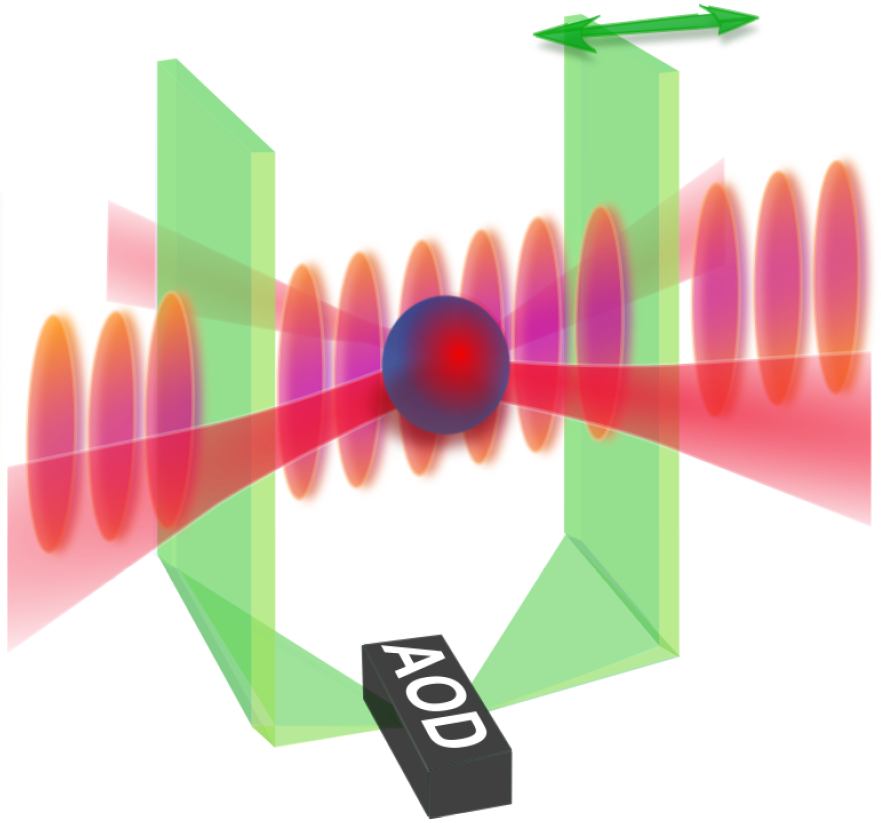
Theoretical work has shown that an optical cavity operating in this regime would provide an effective analogue for studying the behavior of light traveling through curved spacetime. For an optical cavity, however, the need to move a mirror at near-light speeds has so far prevented researchers from creating these conditions. To overcome this problem, David Weld and colleagues at the University of California, Santa Barbara, replaced the solid mirrors with sheets of laser light. In their experimental setup, these light mirrors confine and reflect matter waves of ultracold lithium atoms in a Bose-Einstein condensate. The team created matter waves that propagated at a nearly constant speed, similar to light, but traveling at less than 1 m/s, which made it easier to reach the regime of interest.
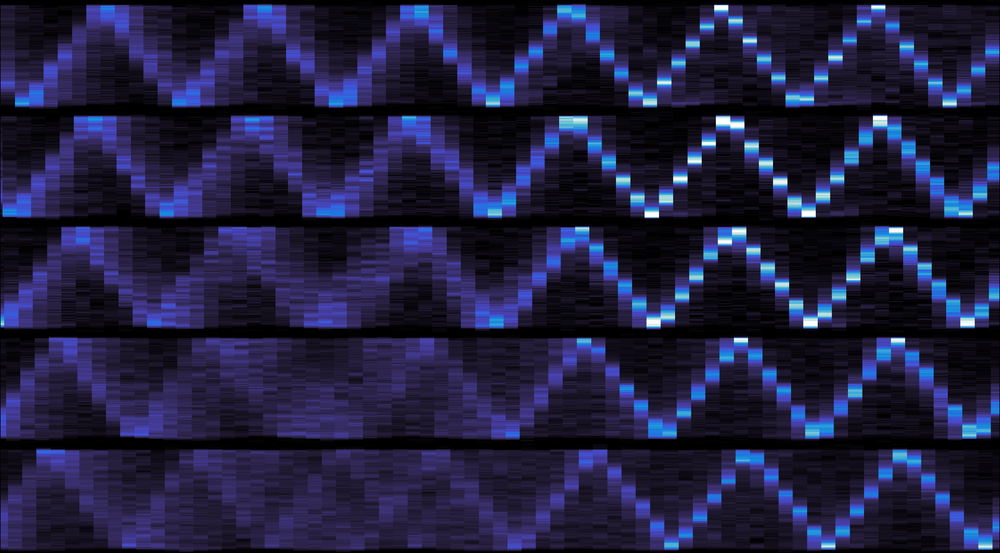
When the light mirrors were static, the matter waves filled the whole cavity and showed no unusual dynamics. But when one of the light mirrors was made to oscillate at a rate close to the cavity’s resonant frequency, around 100 Hz, the matter waves rapidly became concentrated into a single moving pulse. By taking one snapshot per cycle, the researchers found that matter-wave pulses that initially formed away from the stable fixed point always moved toward it within a few cycles.
Weld and colleagues also showed that their matter-wave cavity could generate more complex behavior. When the cavity was driven at twice its resonant frequency, the matter waves formed two distinct pulses, each of which moved toward a different stable fixed point. Another experiment demonstrated time reversal by introducing an abrupt phase shift into the oscillation of the light mirror. The phase shift swapped the stable and unstable fixed points, causing atomic-wave pulses to reverse their direction of motion. “The dynamics we observe, along with the possibility of realizing them in a solid-state platform, points the way to new schemes for compressing and decompressing optical signals,” Weld says.
Weld and colleagues write that driving the mirror vibration with a waveform other than a sine wave could enable the study of other dynamic phenomena that are difficult to observe directly. For example, researchers want to better understand the process that enables cosmic rays to gain energy when the particles are scattered from moving magnetic fields. “This setup allows the authors to explore intriguing physics arising from oscillatory mirror motion near the effective speed of light,” says cold-atom physicist Dominik Schneble of Stony Brook University in New York. He says that possible avenues for investigation include the behavior of photons inside materials, the dynamics of coupled driven cavities, and the spontaneous generation of photons from the quantum vacuum.
–Susan Curtis
Susan Curtis is a freelance science writer based in Bristol, UK.
References
- J. L. Tanlimco et al., “Matter-wave Fabry-Pérot cavity in the ultrastrong driving regime,” Phys. Rev. Lett. 137, 193404 (2026).