




Detecting the Kick of a Single Gas Molecule

For two centuries, collisions between atoms or molecules and small suspended objects have been understood only statistically. In 1827, Robert Brown first described the random motion of pollen in water. Eight decades later, Albert Einstein and Marian Smoluchowski independently explained the jitter as the accumulated effect of countless unseen molecular impacts—convincingly demonstrating the physical reality of atoms and molecules. However, individual kicks were never resolved. Only their collective consequence, Brownian motion, was ever visible. Modern trapped-ion experiments succeeded in watching individual atom–ion collisions perturb a single confined ion’s motion [1]. But there, the “projectile” and the “sensor” were both individual atomic-scale particles of comparable mass. Now David Moore at Yale University and his colleagues have extended single-collision detection to a very different regime [2]. Using an ultrasensitive force sensor in the form of a laser-levitated silica nanosphere (a macroscopic object, roughly 107 times more massive than the atoms striking it), the researchers have detected the momentum transferred by individual gas molecules one collision at a time. This capability could enable sensitive searches for hypothetical fundamental particles, such as those that might constitute dark matter.
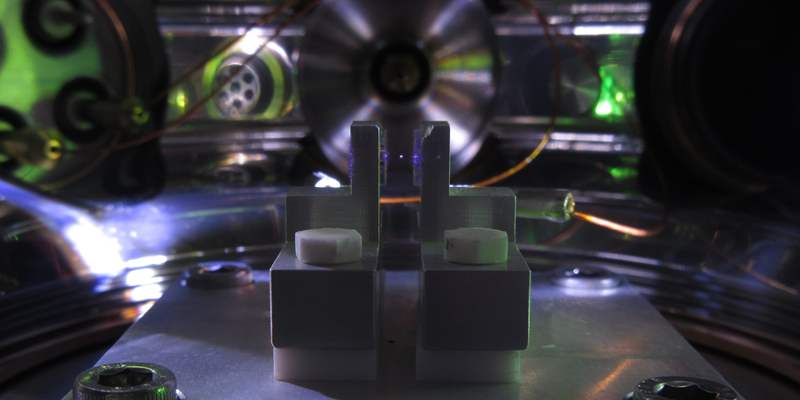
The team’s experiment sits within the fast-growing research field of levitated optomechanics [3]. In the experiment, a small dielectric object—a silica sphere 100 nm in diameter and about 10–15 g in mass—is trapped at the focus of a laser beam (Fig. 1). Thanks to interferometric measurement, the sphere’s position is monitored with extraordinary precision, down to a few picometers. The object levitates in ultrahigh vacuum, held in place only by light. Consequently, it is almost perfectly isolated from its surroundings, coupled to the outside world only through collisions with photons and residual gas molecules.
Thanks to the isolation offered by setups such as this one, levitated optomechanics has proven an excellent platform for sensing static and oscillating forces from a wide variety of sources. The researchers’ work now pushes that capability into new territory: resolving individual impulses, one at a time. This distinction matters. For instance, in several proposed searches for dark matter, a candidate particle would reveal itself through a single sharp momentum kick rather than a continuous force [4–6]. Demonstrating that such kicks can be resolved at all—even from an ordinary, known gas molecule—is a necessary proof of principle for that broader program.
The idea behind the new measurement is straightforward. Any gas molecule that strikes the levitated sphere imparts a small momentum kick. If the sphere’s motion is monitored precisely enough, each kick should show up as a sudden change in the amplitude of the sphere’s natural oscillation in the optical trap.
Moore and his colleagues achieved this measurement by first cooling the sphere’s motion to an effective temperature of roughly 100 mK. They harnessed a parametric feedback scheme that modulated the trap’s stiffness (the strength of its restoring force) in a way that decreased the amplitude of the sphere’s oscillation. This cooling ensured that the sphere’s motion along the direction of laser propagation was stable and predictable and thus suitable for picking out individual collisional kicks.
With the sphere cooled and closely monitored, the team injected small, controlled amounts of three heavy gases (krypton, xenon, and sulfur hexafluoride) into the vacuum chamber one at a time. The researchers then searched the sphere’s position record for brief impulses, essentially comparing the observed motion against the known response of a briefly kicked oscillator. They calibrated this detection scheme using electric-field pulses of known strength applied directly to the sphere (whose charge was maintained at 6 times the elementary charge). The researchers established that they could reconstruct impulses as tiny as 10–23 Newton-seconds, which is a remarkably small mechanical disturbance.
The new observations deliver on two fronts. First, as more gas was introduced into the vacuum chamber, the rate of detected impulse events increased in exactly the way expected from theory. This finding allowed Moore and his colleagues to infer the partial pressure of each gas species directly from the count of individual kicks [7]. Essentially, the researchers realized a pressure gauge whose basic operating principle is counting molecular impacts one by one—rather than relying on ionization currents or other bulk effects used in conventional gauges. Such a direct pressure measurement is attractive at the ultralow pressures relevant to precision experiments, in which standard gauges are unreliable.
Second, the shape of the collision energy spectrum revealed how the gas molecules interacted with the sphere’s surface. Some bounced off elastically, whereas others stuck briefly and then reemerged with a thermalized momentum (one determined mainly by the surface’s temperature). The researchers fit their observed energy spectrum to a modeled spectrum that included both collision types. This step let them determine a key quantity known as a thermal accommodation coefficient for each gas and, simultaneously, infer the surface’s temperature. For all three gases, that temperature was consistent with room temperature, suggesting that the trapping laser did not measurably heat the sphere. This observation seems to differ from earlier experimental indications that laser trapping drives particle temperatures up by several hundred degrees.
The fact that ordinary gas molecules—striking a levitated object under vacuum conditions—can now be individually counted could become an important diagnostic. Gas collisions have long been one of the dominant sources of quantum decoherence. They limit how far levitated particles can be pushed toward exhibiting genuinely quantum behavior (such as motional superpositions) [8]. Being able to characterize those collisions event by event gives experimenters a much sharper tool for understanding and ultimately suppressing that decoherence.
Interest in this line of research is surging. Only a few months after this work first appeared online, a group at the Swiss Federal Institute of Technology (ETH) in Zurich also explored the idea of sensing individual collisions [9]. That team cooled a levitated nanosphere to its quantum ground state and detected momentum kicks from a controlled beam of single xenon atoms fired at the sphere. Together, these studies suggest that resolving single-particle impulses could soon become a routine tool—one whose sensitivity might soon open the door to genuinely new physics.
References
- A. T. Grier et al., “Observation of cold collisions between trapped ions and trapped atoms,” Phys. Rev. Lett. 102, 223201 (2009).
- Y.-H. Tseng et al., “Optomechanical detection of individual gas collisions,” Phys. Rev. Lett. 137, 173601 (2026).
- C. Gonzalez-Ballestero et al., “Levitodynamics: Levitation and control of microscopic objects in vacuum,” Science 374, eabg3027 (2021).
- D. C. Moore and A. A. Geraci, “Searching for new physics using optically levitated sensors,” Quantum Sci. Technol. 6, 014008 (2021).
- Y.-H. Tseng et al., “Search for dark matter scattering from optically levitated nanoparticles,” PRX Quantum 6, 040367 (2025).
- F. Monteiro et al., “Search for composite dark matter with optically levitated sensors,” Phys. Rev. Lett. 125, 181102 (2020).
- D. S. Barker et al., “Collision-resolved pressure sensing,” Phys. Rev. A 109, 042616 (2024).
- O. Romero-Isart et al., “Large quantum superpositions and interference of massive nanometer-sized objects,” Phys. Rev. Lett. 107, 020405 (2011).
- M. Perdriat et al., “Single-atom detection with a quantum-controlled mechanical oscillator,” Phys. Rev. A 114, 023515 (2026).