




Winding Spins Toward Better Quantum Sensing
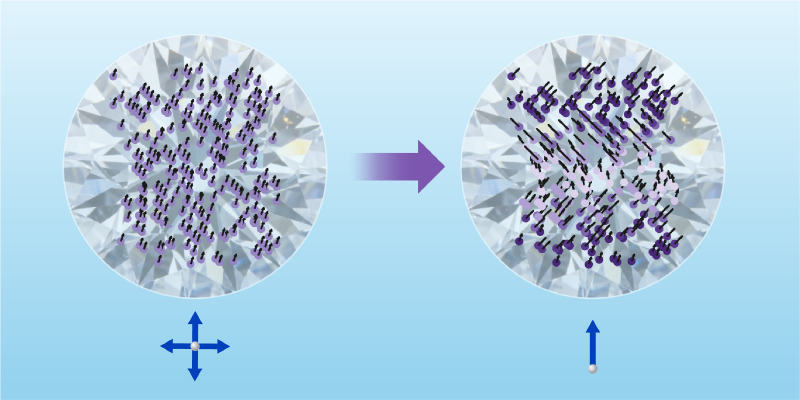

Spins behave like tiny magnetic needles. Their precession in a magnetic field makes them sensitive probes of that field. Being quantum, spins in collective states—such as entangled or squeezed states—can sense better than they do independently. Interactions between spins are key to preparing such states. However, interactions with randomly located nearby spins scramble the collective motion, while interactions with remote spins distributed in 3D space sum to nearly zero. Now Piotr Put at Harvard University and his colleagues have found a way around these obstacles [1]. By winding spin orientations in diamond into a nanoscale spiral and modifying the spins’ interactions using microwave pulses, the researchers sustained collective motion despite the spins’ random positions in 3D space. The team’s approach marks a milestone toward quantum-enhanced magnetic sensing using dense ensembles of solid-state spins.
Quantum measurements are inherently noisy. Because each measurement gives a random result, averaging over many measurements still leaves some unavoidable statistical uncertainty. Entangled or squeezed states of many spins can reduce this uncertainty because if one spin is found pointing in a particular direction, the others have a higher probability of pointing in that same direction than they would if they were independent. In the 1980s, squeezed light was proposed to improve interferometry [2], and this principle now enhances gravitational-wave detection at LIGO [3]. To achieve analogous squeezed states using spins, one route is to generate so-called one-axis-twisting interactions [4]. Here, the precession frequency of one spin depends on how much the other spins are aligned along that spin’s precession axis.
There are various approaches to realizing one-axis-twisting interactions. One is to couple spins via “virtual” photons reflected between mirrors or confined to an optical cavity [5, 6]. But this scheme has been demonstrated only in atomic and solid-state systems that require a strong vacuum and a low temperature. Another strategy is to use spins associated with nitrogen-vacancy centers, defects in diamond consisting of a nitrogen atom next to a missing carbon atom. Such spins are promising quantum sensors under ambient conditions. They have intrinsic dipolar interactions—the same as those between two magnetic needles—that extend over long distances. These long-range interactions can be used to evolve many spins into collective quantum states. Recent experiments demonstrated squeezing [7] and signal amplification [8] in nanoscale spin systems in diamond, but the many-body effects were rather small.
Efforts to extend the number of coupled spins and to sustain their collective coherence in diamond or similar systems, however, run into two obstacles resulting from the inherently random locations of the spins. First, in the standard scenario in which the spins are isotropically distributed in 3D space and uniformly polarized, their dipolar fields cancel each other out (Fig. 1, left). Previous studies of cooperative spin effects in diamond could lift this 3D cancellation only by using thin-slab samples [7, 8]. Second, the dipolar fields from nearby spins add up to a nonzero random local field, scrambling the spin precession and thus limiting the time over which the spin ensemble can develop correlations. Put and his colleagues have tackled both obstacles while retaining a dense, 3D spin ensemble in diamond.
To lift the cancellation of the dipolar fields from distant spins, the researchers broke the uniformity of the spin polarizations by realizing a spiral spin texture (Fig. 1, right). Their trick was to use the gradient of a magnetic field generated by electric currents in microscale electrodes fabricated on the diamond sample. The polarized spins were first tilted from their initial direction by a microwave pulse. They then precessed under the field gradient with location-dependent frequencies, winding into a spiral texture with a submicrometer spatial period, or pitch, along the gradient direction. This setup can be envisioned as stacked nanoscale diamond slabs, with the spins uniformly polarized within each slab but pointing in different directions from one slab to the next. Crucially, the dipolar fields from different slabs do not cancel each other. After the winding process, the researchers switched off the magnetic field and let the spins’ many-body interactions modify the texture. The team then applied an inverse field gradient to unwind the texture, so that only the effects of the interactions were left to be measured through optical readout of the spin states.
To mitigate the phase scrambling caused by random local interactions, Put and his colleagues flipped the spins using a tailored sequence of microwave pulses applied between the winding and unwinding stages. This process dynamically averaged the spins’ anisotropic dipolar coupling to an effective interaction that had full rotational symmetry—that is, the energy of two spins was unchanged when they were rotated together. Because two close spins were under nearly the same external field and precessed almost identically, the symmetrized interaction had negligible impact on the precession. The phase scrambling was greatly suppressed, with only higher-order dephasing effects remaining from the dynamics of three or more neighboring spins.
By combining these two techniques, the researchers observed that the spin ensemble’s precession frequency depended on the spins’ initial tilt angle, a signature of one-axis-twisting dynamics. The symmetrization caused the maximum amplitude of the one-axis twisting to become 3 times larger—and much larger than that seen in the thin-slab samples of the previous studies [7, 8]. Moreover, the precession’s amplitude decayed more slowly as the spiral’s pitch increased, that is, when more pairs of spins precessed synchronously. These observations show that introducing the spiral texture strengthened the spins’ long-range interactions and that dynamically symmetrizing the spins’ local interactions suppressed phase scrambling.
The team’s advance is a leap toward using many-body correlations for quantum technologies. Spins in diamond have good quantum coherence at room temperature, and this work extends the stage for exploring many-body quantum coherence under ambient conditions. One next challenge is to demonstrate the formation of many-body correlations—such as entanglement or squeezing—among the many spins arranged in a spiral texture. Another challenge is to show quantum advantages in technologies, such as an improved signal-to-noise ratio in magnetometry.
The approach developed by Put and his colleagues opens many opportunities. It provides a new control knob for experiments on other dipolar systems, such as arrays of so-called Rydberg atoms, in which spin squeezing has already been demonstrated [9]. But it is not limited to dipolar systems. More generally, a spatially and temporally varying external field could be introduced to engineer the correlation structures in diverse many-body systems. For example, a cavity-mediated spin–spin interaction could be modulated—since its strength depends on the frequency difference between the spins and the cavity—and therefore could be controlled by a time-dependent field gradient. It is not unimaginable that nanoscale spin textures could be used for the quantum simulation of twisted 2D materials such as graphene.
References
- P. Put et al., “Collective many-body dynamics in a solid-state quantum sensor controlled through nanoscale magnetic gradients,” Phys. Rev. X 16, 041043 (2026).
- C. M. Caves, “Quantum-mechanical noise in an interferometer,” Phys. Rev. D 23, 1693 (1981).
- D. Ganapathy et al. (LIGO O4 Detector Collaboration), “Broadband quantum enhancement of the LIGO detectors with frequency-dependent squeezing,” Phys. Rev. X 13, 041021 (2023).
- M. Kitagawa and M. Ueda, “Squeezed spin states,” Phys. Rev. A 47, 5138 (1993).
- O. Hosten et al., “Measurement noise 100 times lower than the quantum-projection limit using entangled atoms,” Nature 529, 505 (2016).
- R. Fukumori et al., “Cavity-mediated coherence protection and one-axis twisting for spins in solids,” arXiv:2604.26909.
- W. Wu et al., “Spin squeezing in an ensemble of nitrogen–vacancy centres in diamond,” Nature 646, 74 (2025).
- H. Gao et al., “Signal amplification in a solid-state sensor through asymmetric many-body echo,” Nature 646, 68 (2025).
- G. Bornet et al., “Scalable spin squeezing in a dipolar Rydberg atom array,” Nature 621, 728 (2023).