




In Memory of Katherine Wright | Physics Magazine
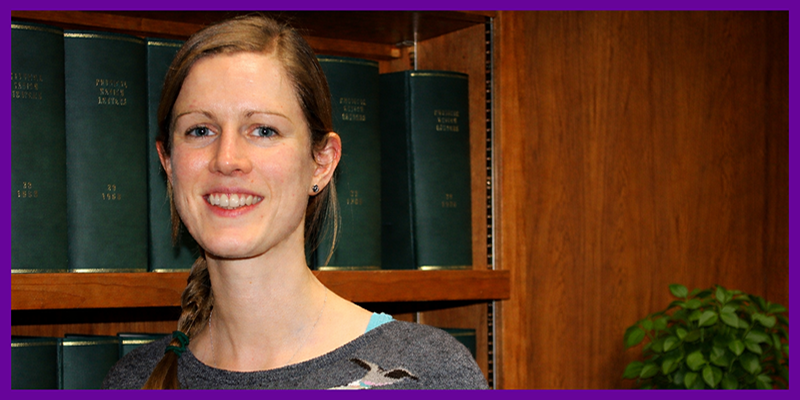

This year, Physics Magazine lost a remarkable writer and a kind, thoughtful colleague. Katherine Wright, whose byline appears on more than 450 stories in our archive, passed away last September, far too early. She was a prolific writer and a passionate advocate for women and minority rights. She is deeply missed by all who had the privilege to work with her.
Katherine’s voice will be familiar to anyone who has read Physics Magazine over the past decade. Her clear-eyed reporting made some of the most complex physics results accessible and human.
Born in Texas and raised in England, Katherine studied polymer physics at the University of Cambridge, UK, earning her PhD in 2010. She received a research fellowship at the Max Planck Institute for Dynamics and Self-Organization, Germany, but soon realized that her true passion lay elsewhere. “I thought I had wanted to be an academic, but I realized partway through that the bit I enjoyed the most was communicating my science,” she recounted in a recent Women in Quantum panel discussion.
She began writing on the side for blogs and other outlets. In 2013, Katherine joined the American Physical Society as an editor for Physical Review Letters. From that perch, she began contributing to Physics Magazine, publishing her first stories later that year. She made a full transition to science writing by joining the magazine’s staff in 2015. While working full time, she also pursued formal training in journalism, earning a master’s degree from Stony Brook University, New York. She was appointed Physics Magazine’s Deputy Editor in 2021.
Over her ten years at the magazine, Katherine played a central role in expanding our coverage, championing timely reporting and more people-centered stories. She constantly encouraged us to seek out a wider range of voices, particularly those from communities historically underrepresented in physics.
Among her many memorable articles were news stories on the first black hole images, on planetary defense systems and on the demonstration of ignition in inertial confinement fusion; a fun story on quantum-inspired poetry; and a review of a book on the contributions of women scientists. Katherine brought rigor and energy to every assignment. She was always up for taking on another story even when her plate was full, and she relished the challenge of explaining the most complex topics with clarity and care. A complete collection of her stories can be found online.
We feel privileged to have worked with Katherine and to have learned from her. She made our magazine better, and we hope her legacy will endure in the breadth of our coverage and in the integrity of our journalism.
Our thoughts are with her family.
–Physics Magazine Editors