




Beware the Funnel: When Simplifying Dynamics Can Mislead

Systems with multiscale dynamics are the norm rather than the exception in nature. Examples include the climate system, where rapid atmospheric fluctuations are coupled to slow ocean and ice-sheet changes, and ecosystems, whose fast population dynamics coexist with much slower evolutionary changes. A standard strategy for studying such systems is to eliminate the fast dynamics altogether by approximating it with either its steady-state value or its time-averaged behavior and then substituting the approximation back into the slow evolution equation [1–4]. In this way, a high-dimensional problem becomes a simple model that can be more easily analyzed. This approach has been highly successful, but now Serhiy Yanchuk of University College Cork in Ireland and colleagues have demonstrated that such simplified models fail to capture a system’s true dynamics and can lead to incorrect conclusions regarding the possible states [5].
The long-term behavior of a dissipative dynamical system is governed by states known as attractors [6, 7], and finding these states can shed light on how the system evolves. The simplest example is a stable fixed point, but attractors can also be periodic orbits, quasiperiodic tori, or strange chaotic attractors. Nonlinear systems can support several coexisting attractors subject to the same parameters—a phenomenon known as multistability. Then, the attractor a system ultimately settles into is no longer determined by the parameters alone but also by the initial condition. The question naturally shifts from “where is the attractor” to “which attractor is reached from where.”
This question is encapsulated by the basin of attraction: the set of all initial conditions that converge to a given attractor as time approaches infinity. Basins partition phase space (and therefore all possible initial conditions) into disjoint regions, and the boundaries of these regions are typically formed by the collection of stable trajectories (manifold) that lead to the unstable states. Basins keep competing attractors apart. The simplest example is an overdamped particle in a double-well potential: The two minima are the stable states, and the maximum between them is the unstable state whose position marks the basin boundary. Every initial condition to the left of the maximum rolls into the left well and every condition to its right rolls into the right one.
A perturbation switches the particle’s fate only if it is large enough to push the particle across the maximum. The system’s ability to resist this change is known as resilience and, in the double-well example, is measured by a single variable: the distance from the boundary. One might expect this clean example of one basin per attractor with an obvious separation to persist in more complex or multiscale systems. But it is precisely the breakdown of this expectation that Yanchuk and colleagues demonstrate.
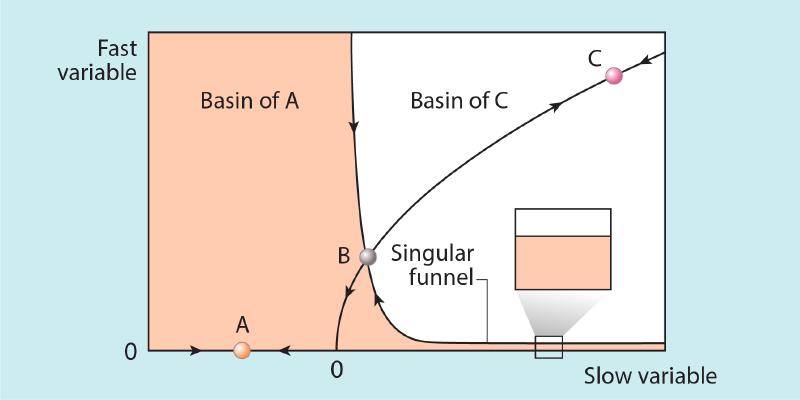
By studying the basin’s boundary, the researchers show that this textbook picture already fails in the simplest possible model of multistability. Known as a supercritical pitchfork bifurcation, this model features a fast state variable that responds to a slowly adapting control parameter. For suitable parameters, this two-variable system is bistable, with two competing stable states separated by an unstable threshold.
The surprise is in the shape of one of the basins, which contains an exponentially thin tongue. The researchers name the basin a singular funnel. This feature clings to the axis along which the fast variable is zero and extends to arbitrarily large values of the slow variable (Fig. 1). A state can therefore be driven to arbitrarily large values of its slow variable and still relax back to its original stable state—provided its fast variable happens to sit inside this tongue. Because the reduced description doesn’t capture the tongue and instead predicts one clean threshold in the slow variable, the effect looks, from the reduced system’s point of view, like a deterministic tunneling event between the two stable states.
The mechanism behind this finding is entirely geometric. Tracking the funnel’s boundary backward in time shows that it hugs the unstable branch of the fast subsystem’s equilibrium curve—the boundary separating the two stable states, along which the slow dynamics evolves. Motion along that branch is slow, while transverse separations contract exponentially fast in reverse time. As a result, the two edges of the funnel get squeezed together the longer they trail along the unstable branch.
This extreme geometric compression makes the funnel’s volume in phase space scale exponentially with the timescale separation, which means that the effect vanishes to all finite orders in power-series expansions. This is precisely why the standard reduced model misses it. Having found analytically that the only relevant ingredient is generic local geometry near an unstable state, Yanchuk and colleagues went on to explore the implications of their results numerically.
They confirmed both the funnel’s existence and its predicted exponential scaling and showed that the mechanism survives under parameter changes. They then reproduced the same phenomenon in other systems, including networks of up to ten coupled rotators, establishing that it is not just a one-off curiosity of a single toy model but evidence of a universal feature of multiscale systems with coexisting attractors.
This work provides a caution against trusting resilience or tipping-point conclusions drawn purely from a reduced model with a single timescale, no matter how large the timescale separation of the original system. Basin stability [8] and related resilience metrics are almost always computed using reduced descriptions because the full multiscale system is too high dimensional to handle directly. Yanchuk and colleagues have shown that such shortcuts can miss entire channels in which systems—either resilient or vulnerable—exist only in the full phase space.
As for next steps, the clean exponential scaling derived for the pitchfork case already breaks down for a network of just two coupled rotators. Analyzing three or more competing attractors is a natural extension. Researchers in the field will also need to reevaluate several prior results. For example, reduced models are a standard tool for assessing the reversibility of climate tipping elements such as the Gulf Stream [9]. Conversely, a system assessed as safely inside its basin could have a hidden narrow escape route out of it.
Lastly, because real systems are never perfectly deterministic, a narrow but persistent funnel may also provide a channel that even weak noise can exploit. A small stochastic perturbation aligned with the funnel could trigger a transition far more readily than the naive picture would suggest. This possibility is directly relevant to forecasting rare, noise-induced regime shifts in climate and ecological systems.
References
- N. G. Van Kampen, “Elimination of fast variables,” Phys. Rep. 124, 69 (1985).
- Synergetics, edited by H. Haken Springer Series in Synergetics (Springer Berlin, Heidelberg, 1977)[Amazon][WorldCat].
- L. A. Segel and M. Slemrod, “Quasi-steady-state assumption: A case study in perturbation,” SIAM Rev. 31, 446 (1989).
- N. Fenichel, “Geometric singular perturbation theory for ordinary differential equations,” J. Differ. Equ. 31, 53 (1979).
- S. Yanchuk et al., “Singular basins in multiscale systems: Tunneling between stable states,” Phys. Rev. Lett. 137, 147202 (2026).
- S. H. Strogatz, Nonlinear Dynamics and Chaos: With Applications to Physics, Biology, Chemistry, and Engineering, 2nd ed. (Westview Press, Boulder, 2015)[Amazon][WorldCat].
- J. Guckenheimer and P. Holmes, Nonlinear Oscillations, Dynamical Systems, and Bifurcations of Vector Fields, Applied Mathematical Sciences, Vol. 42 (Springer-Verlag, New York, 1983)[Amazon][WorldCat].
- P. J. Menck et al., “How basin stability complements the linear-stability paradigm,” Nat. Phys. 9, 89 (2013).
- H. Alkhayuon et al., “Basin bifurcations, oscillatory instability and rate-induced thresholds for Atlantic meridional overturning circulation in a global oceanic box model,” Proc. R. Soc. A. 475, 20190051 (2019).