




Realizing a Spin Chain
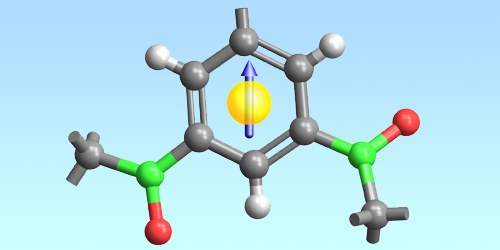

The S = 1 Haldane chain is an infinite 1D string of integer spins that favor pointing in alternating directions like an antiferromagnet. Belying that outward simplicity, the model is physically rich. Its first excited state harbors quasiparticles called magnons, which slosh back and forth under topological protection. Thanks to the magnons’ threefold degeneracy, solving the model analytically is all but impossible. To explore its properties, physicists seek instead to embody it by assembling chains of molecules. Now Mihael Grbić of the University of Zagreb in Croatia and his colleagues have studied the closest physical realization yet [1].
The spins in the S = 1 Haldane chain are free to point in all directions. That isotropy is challenging to reproduce because the likeliest S = 1 spins, doubly charged magnetic ions such as nickel, are found in anisotropic crystals. Grbić and his colleagues turned to an organic nitroxide, which they nicknamed BoNO. The S = 1 spins are formed by electron pairs whose delocalization engenders isotropy. BoNO has two other advantages. The molecules are so bulky that the spins along the chain interact moderately, enabling the study of their rich and delicate physics. Near each spin are three hydrogen ions whose magnetic responses to the magnons’ motions can be readily detected via nuclear magnetic resonance.
Grbić and his colleagues zapped a BoNO crystal with radio waves and recorded how quickly the hydrogen spins relaxed after being polarized by an applied magnetic field. By varying the field and the crystal’s temperature, they mapped the S = 1 Haldane chain’s phase diagram for the first time. They identified when the chain enters one of two states: a Tomonaga-Luttinger liquid, in which spins travel independently of electrical charge as topological excitations; and a Bose-Einstein condensate, in which the spins move in unison. The finding confirmed predictions made decades ago.
–Charles Day
Charles Day is a Senior Editor for Physics Magazine.
References
- I. Jakovac et al., “Magnetic-field-induced Tomonaga-Luttinger liquid and Bose-Einstein condensate phases in an organic S = 1 Haldane chain,” Phys. Rev. Lett. 137, 136702 (2026).