




Tuning Flat Bands
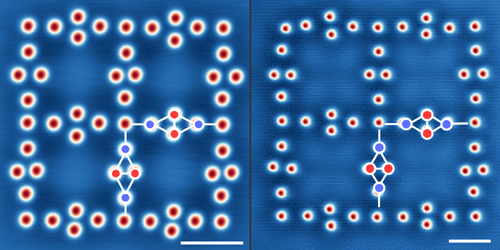

Conduction electrons typically whiz through crystals in broad energy bands. However, some arrangements of atoms conceivably engender so much destructive interference among the electrons’ wave packets that the electrons are corralled into a single, slow-moving lane, a so-called flat band. There, electrons can manifest topological superconductivity or other exotic, many-electron states—at least in principle. Unfortunately, the requisite destructive interference is infinitesimally rare in 3D crystals. Researchers seeking flat bands turn instead to twisted bilayer graphene and other 2D metamaterials. Now Haifeng Ding of Nanjing University in China and his colleagues have developed a new platform for studying flat bands: an artificial lattice of iron atoms on a silver substrate [1].
Ding and colleagues’ starting point is a 2D model, the Lieb lattice, devised in 1989 to investigate itinerant ferromagnetism. The lattice consists of squares with atoms at the corners and at the middle of each edge. Destructive interference localizes the flat-band states at the edge sites, decoupling them from the rest of the lattice and from most of the conduction electrons. Ding and colleagues realized that replacing the atom at each edge site with a rhombus-shaped cluster of four atoms splits the original single flat band into four, whose energies align well with the energy levels of the cluster. Adjusting the four atoms’ separations moves the bands up and down in energy, providing a means to tune the electron population. The researchers tested their recipe by using a low-temperature scanning tunneling microscopy system to arrange 57 iron atoms on a silver substrate. Next up: exploring flat-band physics at different temperatures and applied magnetic fields.
–Charles Day
Charles Day is a Senior Editor for Physics Magazine.
References
- H. T. Li et al., “Cluster-decorated Lieb lattice: A convenient and reliable platform for tuning flat-band energy,” Phys. Rev. Lett. 137, 176401 (2026).