




Hybrid Quantum Computer Could Simulate Both Fermions and Bosons
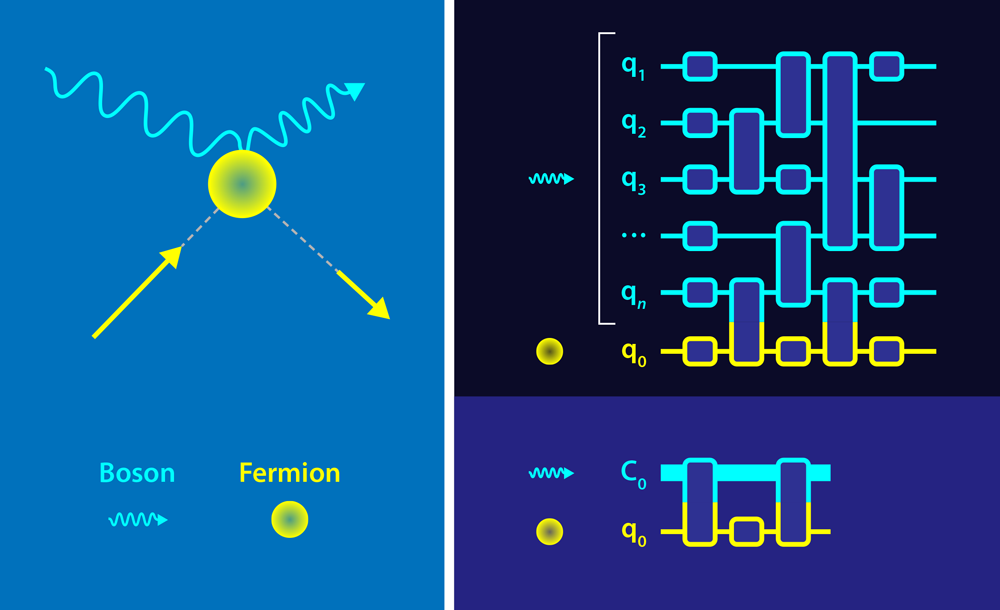

Performing simulations of quantum systems on an ordinary computer is fundamentally difficult. The resources required to track the state of a quantum system grow exponentially with the size of the system. Therefore, even modest-sized simulations can exceed the capacity of the largest supercomputers. In 1982, Richard Feynman proposed using a controllable quantum system as the computer, so that the quantum mechanics of the machine itself performs the computation [1]. This proposal has grown into a worldwide effort to build quantum computers made up of large numbers of quantum bits, or qubits. But simulating fundamental physics poses a special challenge, as the two classes of particles—fermions and bosons—map to qubits in distinctly different ways. A new theoretical proposal by Eleanor Crane from MIT and colleagues describes a hybrid approach in which the components of the hardware match the fermions and bosons that are being simulated [2]. The researchers model the performance of this hybrid computer for a specific problem in particle physics, and they find that this strategy could perform better than traditional architectures that contain only qubits.
The particles found in nature come in two families. Fermions, such as electrons and quarks, are the particles that make up matter. Bosons, such as photons and gluons, are those that mediate the fundamental forces. When large numbers of fermions and bosons interact strongly, such as inside a proton or in a high-temperature superconductor, classical methods of computing struggle to determine the system’s behavior [3, 4].
Quantum computers could offer a way forward. Quantum hardware is currently being developed in several forms, including superconducting circuits, trapped ions, and neutral atoms. Nearly all these efforts follow the same strategy in which the basic computational units are qubits—isolated systems that can be placed in one of two discrete quantum states. This restricted state space makes qubits well suited for simulating fermions. The Pauli exclusion principle limits each fermionic mode to two states, empty or occupied, which is exactly what a qubit can represent. Bosons are more difficult. A single bosonic mode can hold any number of particles, or “quanta,” so its state must be truncated at some maximum occupation and spread across a register of several qubits. Simulating the behavior of a boson requires a long sequence of gate operations on these qubits. And because qubits are prone to errors, extra resources are needed for error correction [5]. This large overhead has limited the ability of qubit-based computers to simulate systems with many bosons [6].
Crane and colleagues propose a strategy for reducing this overhead by utilizing hardware that already contains bosonic modes. In superconducting platforms, qubits are routinely coupled to microwave-cavity resonators, centimeter-scale metal boxes in which the electromagnetic field oscillates at a fixed frequency. The electromagnetic field in the cavity is a native bosonic mode with long coherence times. However, these modes have mostly been used to enable gate operations between qubits and to read out their states. Crane and colleagues imagine using the cavities as full computational registers. They develop a universal set of operations for a hybrid processor in which both qubits and cavities store quantum information [2, 7]. The operations do not require a hardware redesign. Indeed, the researchers show that information stored in cavities can be processed with operations that are already available within superconducting platforms. The advantage is that the number of operations required to manipulate a bosonic mode is roughly independent of how many quanta it holds. This hybrid strategy removes the computational cost of compiling bosons into qubits (Fig. 1).
As an example of this formalism, Crane and colleagues consider a toy model—the lattice gauge theory coupled to bosonic matter—which has the same basic gauge-field structure as the Higgs sector of the standard model of particle physics [8]. Theories of this kind are standard test models for developing quantum simulations of nuclear and particle physics [4, 9, 10]. The researchers imagine a hybrid computer simulating this toy model, and they calculate its expected performance. Their analysis starts with realistic hardware specifications, including photon loss and qubit decay, and ends with explicit algorithms for simulating the dynamics of the theory. They find that a hybrid processor with gate error rates of 0.1% would simulate the theory with the same accuracy as a qubit-only machine with gate error rates of 0.001%. To put this in perspective, current state-of-the-art quantum computers have gate error rates of about 0.1%. Reaching 0.001% would require quantum error correction that is beyond current technology.
The researchers also compare their hybrid method against the best available classical methods, tensor-network techniques, which simulate a quantum system by compressing its state on an ordinary computer. This compression works only while the entanglement in the system remains modest. In the case of the toy model, Crane and colleagues show that the entanglement between particles increases over time, causing the compression to fail after a relatively short amount of time evolution. The implication is that a hybrid processor with gate fidelities near 99% (equivalent to a 1% error rate) could outperform a classical computer in simulating many aspects of particle physics [3].
In my view, the most encouraging aspect of this proposal is how modest the hardware requirements are. These requirements can be met by near-term devices without waiting for quantum error correction. The formalism should be generalizable to other quantum computing platforms: Trapped ions and neutral atoms have native bosonic modes in the motion of the atoms themselves, and the same techniques can be applied there. This proposal also demonstrates how progress in quantum computing is made. Building and using these machines is a multidiscipline challenge. It requires people who understand the hardware, people who understand how to compile algorithms onto it, and people who understand the physics well enough to choose the right problems and approximations. Crane and colleagues bring this broad range of expertise to a hybrid scenario, which they trace out from the physics of microwave cavities up to a gate-by-gate cost estimate for a specific high-energy physics problem. This work provides a concrete target for hardware development, and the required gate fidelities are close to what existing devices already achieve.
References
- R. P. Feynman, “Simulating physics with computers,” Int. J. Theor. Phys. 21, 467 (1982).
- E. Crane et al., “Hybrid oscillator-qubit quantum processors: Simulating fermions, bosons, and gauge fields,” Phys. Rev. X 16, 041008 (2026).
- C. W. Bauer et al., “Quantum simulation for high-energy physics,” PRX Quantum 4, 027001 (2023).
- Y. Alexeev et al., “Quantum-centric supercomputing for materials science: A perspective on challenges and future directions,” Future Gener. Comput. Syst. 160, 666 (2024).
- Google Quantum AI, “Quantum error correction below the surface code threshold,” Nature 638, 920 (2024).
- N. Klco and M. J. Savage, “Digitization of scalar fields for quantum computing,” Phys. Rev. A 99, 052335 (2019).
- Y. Liu et al., “Hybrid oscillator-qubit quantum processors: Instruction set architectures, abstract machine models, and applications,” arXiv:2407.10381.
- E. Fradkin and S. H. Shenker, “Phase diagrams of lattice gauge theories with Higgs fields,” Phys. Rev. D 19, 3682 (1979).
- R. C. Farrell et al., “Quantum simulations of hadron dynamics in the Schwinger model using 112 qubits,” Phys. Rev. D 109, 114510 (2024).
- A. N. Ciavarella and C. W. Bauer, “Quantum simulation of SU(3) lattice Yang-Mills theory at leading order in large-Nc expansion,” Phys. Rev. Lett. 133, 111901 (2024).