




A Type-I Superconductor Breaks Time-Reversal Symmetry
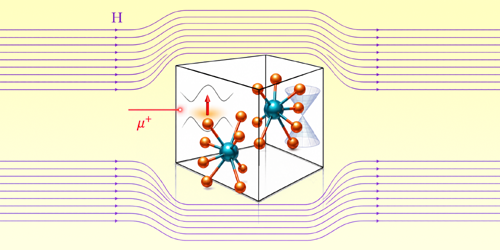

Superconductors can be broadly classified along two independent lines: conventional versus unconventional (defined by the mechanism by which their electrons form Cooper pairs), and type I versus type II (defined by their response to external magnetic fields). Most instances of unconventional pairing discovered to date are in type-II superconductors. Now Anshu Kataria of the Indian Institute of Science Education and Research Bhopal in India and her colleagues have found evidence of unconventional pairing in a type-I superconductor [1]. The discovery could offer a new platform for studying unconventional pairing, free from the influence of exotic phenomena that are often seen in type-II superconductors.
Kataria and her colleagues synthesized single crystals of YbSb2, a material whose complex crystal structure is found in both conventional and unconventional superconductors. They first confirmed the material’s type-I superconducting properties using complementary measurements of electrical resistivity, magnetization, and heat capacity. Then, using two versions of a technique called muon spin spectroscopy, they detected the spontaneous emergence of tiny internal magnetic fields below the superconducting transition temperature. The existence of these fields is direct evidence of time-reversal symmetry breaking, which is a hallmark of unconventional electron pairing.
To determine the electronic band structure that gives rise to this unconventional pairing, the researchers modeled the material using first-principles calculations. They identified YbSb2 as a 2 topological metal—a material whose band structure results in distinct, symmetry-protected surface states. In its bulk superconducting state, Cooper pairs are formed through interband pairing in an unconventional “spin-triplet” configuration, where electron pairs have parallel spins rather than the antiparallel spins of conventional pairing. Further analysis by the team suggested that these properties make YbSb2 capable of hosting so-called gapless Majorana surface modes, a trait that could one day be used for fault-tolerant quantum computing.
–Rachel Berkowitz
Rachel Berkowitz is a Corresponding Editor for Physics Magazine based in Vancouver, Canada.
References
- A. Kataria et al., “Observation of time-reversal symmetry breaking in the type-I superconductor YbSb2,” Phys. Rev. Lett. 137, 136002 (2026).