




Quasicrystalline Water Waves
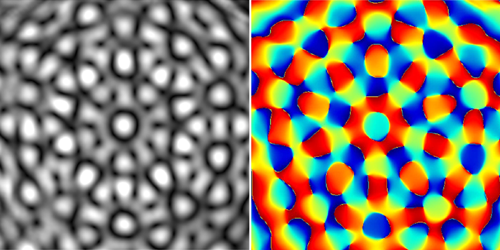

Soon after quasicrystals made their debut in 1984, physicists realized that the ordered, nonrepeating structures could be thought of as projections of periodic structures in higher dimensions. Now Jun-liang Duan of Xiamen University in China and his colleagues have made 2D quasicrystals out of shallow water waves [1]. From the waves’ evolving distributions of vertical height and horizontal gradient, the researchers constructed a 3D vector field. Analyzing the field revealed topological structures called skyrmions—table, vortex-like swirls—that were inconspicuous in the 2D patterns.
Archetypal quasicrystals have fivefold symmetry. To make their hydrodynamical quasicrystals, Duan and his colleagues arranged five flat actuators in a pentagonal pattern in a tray of water. The actuators launched waves that converged at a central point. Interference among the five waves, which had identical amplitudes and wavelengths, created quasicrystalline patterns.
Three distinct fivefold quasicrystalline patterns formed, one after the other, depending on the waves’ relative phases. These patterns turned out to correspond to different slices through the same 3D vector field. What’s more, their characteristic features could be represented by simple quantities akin to the vectors crystallographers use to describe defects. Nontrivial topological structure was also present in the form of skyrmions. Hints of these features had been seen before in plasmonic quasicrystals, but they were harder to confirm because of those crystals’ much faster dynamics. The hydrodynamical skyrmions exhibit dynamically evolving boundaries and orientations. Moreover, Duan and his colleagues found that the vortices embedded in the quasicrystal lattices could trap and rotate small polystyrene spheres floating on the water’s surface.
–Charles Day
Charles Day is a Senior Editor for Physics Magazine.
References
- J.-L. Duan et al., “Quasicrystal topological hydrodynamics,” Phys. Rev. X 16, 031078 (2026).