




How to Tell If Your Excitons Have Condensed
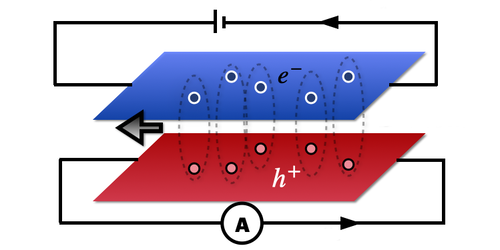

In some materials, an electron and a hole (the absence of an electron) can bind together to form an exciton. Under the right conditions, a group of excitons can form a Bose-Einstein condensate (BEC), a quantum entity that could potentially be used for low-power circuits. For a long-lasting BEC, researchers create the excitons in a sandwich-like microstructure (a bilayer) in which electrons are restricted to one atomic layer and holes to another—but they can still pair up. However, existing tests for exciton condensation can be either challenging to perform or yield ambiguous results. Now Jun-Xiao Hui and Qing-Dong Jiang of Shanghai Jiao Tong University have proposed a simple test to determine if excitons in certain bilayers have formed a true BEC [1].
One property of the BEC is that when an electron current is driven in one layer, an equal hole current appears in the other layer because of the tight binding between electrons and holes. This effect, known as perfect Coulomb drag, is eliminated when the drive current reaches the so-called critical current. However, this effect was recently shown to occur even in a noncondensed state [2, 3].
Hui and Jiang showed theoretically that a more definitive signature should emerge if the two layers have spin–orbit couplings of differing strengths—meaning that the charge carriers’ energies depend differently on spin—and if suitable electric and magnetic fields are applied. Under these conditions, the critical currents in opposite directions differ—but only in the BEC state. The researchers say that this test should be easy to implement with current technology and readily available materials.
–David Ehrenstein
David Ehrenstein is a Senior Editor for Physics Magazine.
References
- J.-X. Hui and Q.-D. Jiang, “Nonreciprocal perfect Coulomb drag in electron-hole bilayers: Coherent exciton superflow as a diode,” Phys. Rev. Lett. 137, 136001 (2026).
- P. X. Nguyen et al., “Perfect Coulomb drag in a dipolar excitonic insulator,” Science 388, 274 (2025).
- R. Qi et al., “Perfect Coulomb drag and exciton transport in an excitonic insulator,” Science 388, 278 (2025).