




Time Delay Probes Quantum Light
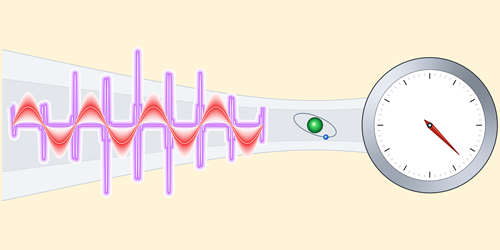

By exposing atoms to intense laser light and detecting the emitted electrons, researchers can infer ultrafast electron dynamics occurring during the ejection process. The techniques employed typically use light that behaves classically, raising the fundamental question of whether using expressly prepared quantum light could unmask different properties. Now Yueming Zhou at Huazhong University of Science and Technology in China and his colleagues have demonstrated that the statistics of quantum light can be imprinted on the electrons, offering a sensitive probe of those statistics [1].
Zhou and his colleagues considered a well-established technique known as reconstruction of attosecond beating by interference of two-photon transitions (RABBIT). In RABBIT, a train of extreme-ultraviolet pulses ionizes a collection of atoms, and a delayed infrared pulse probes the emitted electrons. An electron of a given energy can reach the same final state through two distinct pathways: In one it absorbs an infrared photon, and in the other it emits an infrared photon. These two pathways interfere, causing the intensity of certain peaks in the electron-emission spectra to vary periodically as the probe pulse’s delay is increased. The phase of these oscillations can be used to infer the time between the ionizing pulse and the electron emission—typically tens to hundreds of attoseconds.
The researchers theoretically studied what happens when the probe pulse is prepared in a squeezed-vacuum state—a highly quantum state of light with large intensity fluctuations. The team found that these fluctuations shift the phase of the oscillations in the electron-emission spectra. Because this phase normally reflects the emission time, the phase shift would look like an apparent delay—of up to tens of attoseconds. Crucially, the shift depends on the statistics of the quantum light, meaning that the electrons could be used to learn about those statistics.
–Ryan Wilkinson
Ryan Wilkinson is a Corresponding Editor for Physics Magazine based in Durham, UK.
References
- L. Li et al., “Photon-statistics time delay in quantum attosecond photoelectron interferometry,” Phys. Rev. Lett. 137, 163201 (2026).