




Illuminating Quantum Ferroelectrics
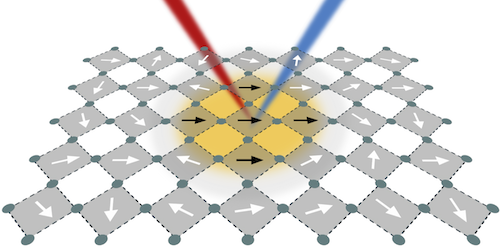

In classical ferroelectric materials, electric dipoles in the material line up over a long range such that the bulk exhibits polarization when the material is cooled past a critical temperature. In a quantum ferroelectric, the material is on the verge of forming this bulk-ordered state as it is cooled near 0 K, but long-range order is suppressed by quantum fluctuations. Researchers debate the microscopic mechanisms that lead to this quantum ferroelectric critical point. Some think the bulk-ordered state results from the collective motion of atoms, while others think it occurs after local electric dipoles align in nanometer-scale regions that subsequently merge. Both pictures have supporting experimental evidence, but on different timescales and length scales. Now Wencan Jin of Auburn University in Alabama and colleagues have used a novel optical technique to find new evidence consistent with nanometer-scale regions aligning first [1].
The researchers studied the quantum ferroelectric material electron-doped strontium titanate (SrTiO3) using a technique known as rotational-anisotropy second-harmonic generation (RA-SHG). They irradiated the material with ultrafast pulses of linearly polarized light, whose incident angle they rotated relative to the crystal. The scattered light emerged at a doubled frequency and at an angle that gave information about the material’s crystalline symmetry. As the local electric dipoles developed, the angular distribution of the scattered signal varied. The measurements indicated that nanometer-scale polarized regions formed before the macroscopic ferroelectric phase emerged. The researchers say that RA-SHG can be used to study other emergent orders in a wide range of quantum materials.
–Sophia Chen
Sophia Chen is a freelance science writer based in Columbus, Ohio.
References
- M. Kandil et al., “Optical poling of a quantum ferroelectric metal across the order-disorder phase transition,” Phys. Rev. Lett. 137, 166801 (2026).