




Enzymes Strongly Affect Sequestered Biomolecules
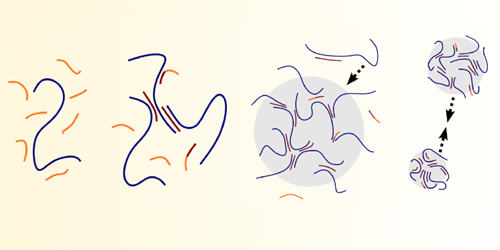

A biomolecular condensate is a small region within a cell where specific biomolecules are temporarily concentrated—sequestered like oil droplets in water—for a particular purpose, such as surrounding and transporting messenger RNA strands. Researchers have determined many properties of condensates using model systems in the lab, but these studies rarely account for the effects of enzymes, which control a condensate’s state in a cell. Now Guillaume Tresset of the University of Paris-Saclay and his colleagues have directly compared the structure of a model condensate under two different formation mechanisms—one controlled by an enzyme (“active”) and one that happens automatically without such control (“passive”) [1]. The actively formed condensate’s structure was quite different, which suggests that enzymes’ effects can be significant.
The researchers created model condensates using strands of RNA mixed with a ten-amino-acid chain (a peptide). These two components automatically formed condensates if the peptide was in its native state. But with phosphate groups (PO43–) added, the extra negative charges prevented a condensate from forming unless a phosphate-removing enzyme was present.
To study the condensates’ properties over a wide range of temporal and spatial scales, Tresset and his colleagues performed simulations and three types of experiments: x-ray scattering, fluorescence recovery (which measures diffusion rates), and microscopy. They found that in the passive case, without phosphates, the peptide–RNA mixture formed dense condensates. But for the active case, in which condensate formation required an enzyme, the RNA strands began entangling with one another before the enzyme had finished removing phosphate groups. This entanglement led to a more porous, mesh-like structure. Tresset says that this more open structure could allow small molecules to travel more easily within the condensate and thus accomplish cellular functions more efficiently than in the denser structure.
–David Ehrenstein
David Ehrenstein is a Senior Editor for Physics Magazine.
References
- T. Sundararajan et al., “Enzymatically driven remodeling of growth kinetics and internal structure in biomolecular condensates,” PRX Life 4, 043001 (2026).