




A Little Noise Helps a Soft Valve Close
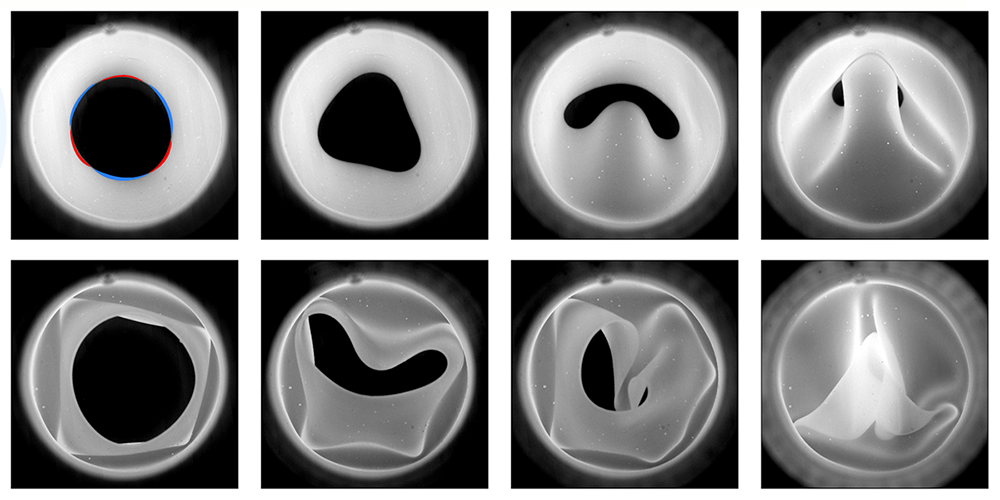

We are all familiar with the rigid valves that control the flow of water through the heating system or to kitchen taps. Valves are also ubiquitous in nature—although they are often soft rather than rigid. In plants and fungi, for example, soft valves passively regulate fluid flow through internal transport networks, without the need for active control [1]. Their compliance—the extent to which these structures deform under pressure—enables them to alter the geometry of fluidic channels, a behavior that lies at the heart of soft hydraulics [2]. Flexible valves are also found in the cardiovascular system. The mitral valve in the heart, for example, deforms and closes to prevent the backward flow of blood. Cardiovascular valves operate in larger channels and under faster flows than their counterparts in plants and fungi. Under these conditions, the inertia of the fluid becomes important and its flow can be subject to random fluctuations. Now Mengfei He of Harvard University and colleagues have shown that adding noise-like fluctuations to the flow can help a soft valve close at a pressure about 10 times lower than that required for unperturbed flow [3]. This finding could inform the design of soft valves that close reliably at low pressures for biomedical and other applications.
The function of a soft valve relies on a feedback loop between fluid pressure and structural deformation: Pressure deforms the valve, which alters the flow and in turn changes the pressure load on the valve. Thus, geometrical features such as the cross-sectional area of a channel, which remain fixed in rigid structures, can vary in response to the fluid flow. This feedback makes the valve’s pressure–flow response nonlinear. To see why, consider a rigid channel carrying a viscous fluid at low Reynolds number, such that the flow is smooth and dominated by viscosity. In this regime, the flow rate is proportional to the applied pressure difference, much like electric currents governed by Ohm’s law. A soft valve, by contrast, deforms as the pressure varies, changing the channel’s effective cross-sectional area and making this relationship nonlinear.
Researchers design soft valves to passively control fluid flow in microfluidic devices and soft robots, where small channel dimensions typically keep Reynolds numbers low. For example, fluid forces can induce the snap-through of an elastic arch in a channel, thereby modifying its hydraulic resistance [4], or cause a spherical shell to turn inside out and shut off an internal channel [5]. In these cases, the critical flow rate is set by a deterministic balance between viscous and elastic stresses. Fluid inertia is negligible, and hydrodynamic fluctuations do not play an essential role in triggering these instabilities. Other types of soft valves, however, operate in a qualitatively different regime.
Cardiovascular valves such as the mitral valve exemplify such a regime. The mitral valve consists of soft leaflets arranged around an annulus and tethered by thin, string-like cords. Together, these components form a deformable orifice that closes when the pressure gradient reverses, preventing backflow. The valve operates in a dynamic environment characterized by large Reynolds numbers, substantial fluid inertia, and fluctuating loads. Unlike that of engineered soft valves operating in the viscous regime, the closure of the mitral valve can only be understood by accounting for the interplay between deformation and unsteady flow. The valve’s anatomical complexity, however, makes it difficult to identify the physical mechanisms that initiate closure. This challenge motivates the study of a simpler system that retains the essential coupling between fluid flow and elasticity without reproducing every anatomical detail.
He and colleagues addressed this challenge in two stages. First, they studied a freshly harvested (nonbeating) porcine heart, applying a reverse pressure difference across its mitral valve. They tracked the area of the orifice over time under different reverse pressure gradients. Under weak loading, the mitral leaflets deformed only slightly. But once the pressure difference exceeded a certain threshold, they underwent large deformations, shutting off the valve. In this state, the leaflets came into contact and sealed the orifice, forming a so-called coaptation state.
To isolate the physics underlying this transition, the researchers constructed a physical model of the valve: a thin, elastomeric conical shell with a circular opening at its tip, mounted inside an acrylic tube. They drove water through the tube while measuring the flow rate and pressure drop and recording the shell’s opening deformation with a high-speed camera (Fig. 1). When the fluid impinged on the cone, its opening initially narrowed slightly. But above a critical flow rate, the cone abruptly collapsed and the opening closed. Remarkably, the simplified cone reproduced both the sudden closure of the porcine valve and its final coaptation geometry: As the rim folded inward, its different sections met along a branched line of contact, sealing the opening.
Combining their experimental results with a simplified fluid–structure-interaction model, the researchers showed that flow fluctuations can cause the valve to close well below its steady-flow threshold. Under steady flow, the model predicts that the conical shell buckles once the adverse pressure reaches a well-defined threshold value. Because shell buckling is a “subcritical” instability, however, the onset of buckling is highly sensitive to imperfections and sufficiently large disturbances [6]. Flow fluctuations can therefore trigger an early transition to coaptation. Indeed, in the experiments the researchers introduced additional noise into the flow, leading the cone to close at pressures nearly an order of magnitude smaller than under steady forcing. The model also predicted the amplitude of a brief disturbance needed to trigger closure on demand, a prediction that the researchers confirmed experimentally.
This work suggests that flow fluctuations, often treated as unwanted noise, may play a role in the reliable operation of soft valves. More work is needed to conclusively establish whether biological valves exploit this mechanism. In engineered systems, however, this behavior could offer a new design route to soft valves that switch rapidly and passively, using fluctuations in the flow itself as part of their control mechanism. More broadly, this principle could guide the design of fluidic devices that harness the natural variability of their environment to achieve a desired function.
References
- J.-F. Louf et al., “Bending and stretching of soft pores enable passive control of fluid flows,” Phys. Rev. Lett. 125 (2020).
- I. C. Christov, “Soft hydraulics: From Newtonian to complex fluid flows through compliant conduits,” J. Phys.: Condens. Matter 34 (2021).
- M. He et al., “Stochastic elastohydrodynamics of soft valves,” Phys. Rev. Lett. 137, 158401 (2026).
- M. Gomez et al., “Passive control of viscous flow via elastic snap-through,” Phys. Rev. Lett. 119 (2017).
- P. G. Ledda et al., “Fluid-induced snap-through instability of spherical shells,” Phys. Rev. Lett. 135, 234002 (2025).
- J. M. T. Thompson, “Advances in shell buckling: Theory and experiments,” Int. J. Bifurc. Chaos 25, 1530001 (2015).