




Spinning Liquid into Solid
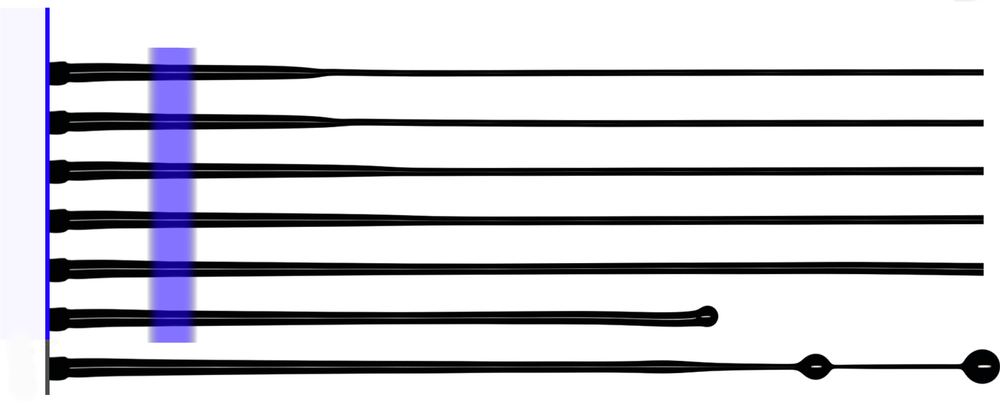

In traditional spinning, fibers are twisted together into a continuous strand. In modern manufacturing, spinning can involve drawing out liquid streams to produce solid filaments that are woven into advanced materials. But the process is complex and challenging to model theoretically. Now researchers have shown how to greatly simplify the process by using light to catalyze solidification within a stream of freely falling liquid [1]. The technique may offer more control over the manufacture of fibers than current methods can provide.
The complexity of most modern force-driven spinning arrangements led fluid mechanics expert Henri Lhuissier of Aix-Marseille University in France and his colleagues to develop a simpler technique. “Most manufactured fibers are spun,” he says, “but what happens is mostly unpredictable due to the complexity of chemistry, phase changes, fluid mechanics, and other factors.” He says that much remains unknown about how solidification takes place and, therefore, what the ultimate size of the fiber will be.
Lhuissier and his colleagues undertook experiments with tiny jets of a photocurable liquid, for which the application of ultraviolet light can trigger a change from liquid to solid. They pumped this fluid downward through a vertical nozzle to create a liquid jet falling freely under gravity.
The researchers placed a ring of focused, high-intensity ultraviolet LEDs about 5 mm below the nozzle. With the lights off, the fluid stream accelerated downward and eventually broke up into a series of falling droplets. With the lights on, a polymerization reaction was triggered that quickly transformed the fluid jet into a solid-like thread.
Lhuissier and colleagues demonstrated that this fast transition drastically simplifies the physical behavior of the jet, making modeling easier. Above the light ring, the accelerating liquid is completely unaffected by the solid phase below. Just below the light, the liquid stretches into a thinner solid thread as a result of the hanging weight of the fiber below. By varying the light intensity, the researchers found that they could reliably determine the exact location where the liquid became solid, controlling whether the stream settled into a smooth continuous fiber, a string of connected beads, or a collection of separate droplets.
The researchers then showed that these results could be predicted by theory. They combined a momentum-balance equation around the transition zone with a chemical kinetics model tracking the light-induced polymerization progress. They derived a simple, parameter-free equation for the final fiber radius involving only gravity, inertia, and a fluid property called capillarity. This equation reliably predicted the radii they measured.
“This paper is really beautiful,” says fluid dynamics expert Detlef Lohse of the University of Twente in the Netherlands. “Using light to induce solidification in a liquid jet is a highly original idea that opens up great opportunity for controlling spinning and fiber production,” he says. “This work nicely combines very careful experiments with a deep theoretical analysis.”
In the future, the team hopes to explore how these simplified dynamics apply when the solidification of the liquid is more gradual or when air drag plays a larger role. This approach, the researchers suggest, could improve industrial manufacturing by reducing a lot of trial and error in fiber fabrication. By replacing slow thermal or chemical gradients with localized light triggers, manufacturers could precisely tailor fiber geometries and also potentially run high-speed spinning lines in which fibers would be chopped into segments on the fly by short bursts of light.
–Mark Buchanan
Mark Buchanan is a freelance science writer who splits his time between Abergavenny, UK, and Notre Dame de Courson, France.
References
- JS. Smink et al., “Fast solidification of a gravity-stretched liquid jet,” Phys. Rev. Lett. 137, 144004 (2026).