




The Turbulent Life of a Vortex Line
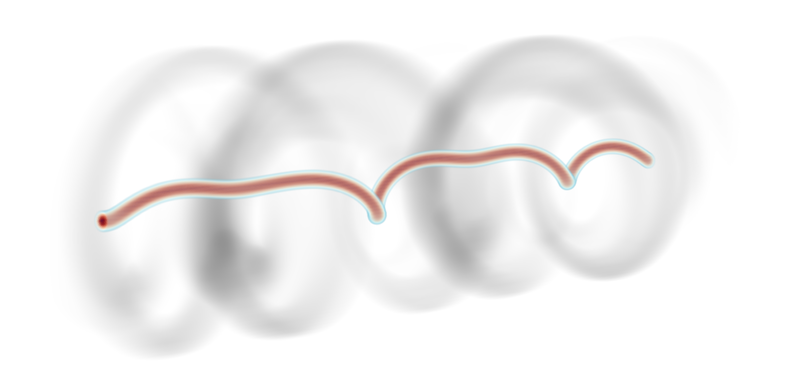

When you pull the plug at the end of a relaxing bath, a vortex forms as water drains through the plughole. If you watch carefully, the slender whirlpool may begin to wobble, with helical, corkscrew-like disturbances traveling along its length. In 1880, William Thomson, who later became Lord Kelvin, showed mathematically that a straight vortex filament can support such helical waves [1]. Today, Kelvin waves are thought to hold the key to one of the outstanding puzzles of quantum turbulence: how the kinetic energy of an agitated quantum fluid is ultimately dissipated. Now Eric Falcon of Paris Cité University and his colleagues have directly observed Kelvin-wave turbulence using a vortex no more exotic than one found in a bathtub [2].
Kelvin waves are particularly important in superfluids, ultracold atomic gases, and the interiors of neutron stars. Rather than being spread throughout the fluid, superfluid vorticity is confined to thin, line-like topological defects, each carrying a fixed quantum of circulation (Fig. 1) [3]. A tangle of these so-called quantum vortices forms quantum turbulence—“superfluid spaghetti”—first envisaged by Richard Feynman in the 1950s [4]. This picture raises a fundamental question about the fate of the energy stored in the vortex tangle. In classical turbulence, energy cascades to small scales where it is dissipated by viscosity. But an ultracold superfluid is inviscid. How, then, does turbulent motion in a superfluid eventually decay?
The prevailing picture for superfluid turbulence hinges on a dual energy cascade. On the largest scales, energy is transferred first through a cascade of progressively smaller eddies until their size reaches the typical spacing between neighboring vortices [3]. At that point, vortex filaments reconnect. Each reconnection plucks the vortex lines like a guitar string, launching Kelvin waves [5]. These waves then interact nonlinearly—that is, they scatter, exchange energy, and generate entirely new wave frequencies. In doing so, they transfer energy to progressively shorter wavelengths in a second energy cascade. Eventually, the wavelengths become sufficiently short that energy can be radiated away through phonons, providing the final leg of the journey by which turbulence dissipates.
Understanding the Kelvin-wave cascade has proven to be a formidable challenge. Quantum turbulence is typically analyzed using weak wave turbulence (WWT) theory, which assumes that nonlinearity is weak, waves are dispersive (their velocity depends on wavelength), and their phases are random. The theory forbids resonant interactions among odd numbers of waves because of symmetries and deems four-wave interactions to be trivial because they do not result in any net exchange of energy. That leaves only six-wave interactions to drive the cascade [6]. Competing theoretical descriptions within WWT differ in the precise form of these interactions and therefore predict slightly different power-law spectra of wave energies [7, 8]. However, they agree that Kelvin-wave turbulence should emerge through this nonlinear mechanism. Although numerical simulations have provided strong support for this picture [9], direct experimental evidence has remained elusive.
The experimental difficulty arises from the sizes of the vortices. In quantum fluids, the vortex cores are just nanometers across, making it extraordinarily challenging to observe Kelvin waves directly, let alone follow their nonlinear interactions across many length scales. Rather than tackling this problem head-on, Falcon and his colleagues exploited the fact that Kelvin waves are a general feature of vortex filaments and can be studied instead in a cleverly designed classical analogue.
In their elegant refinement of a draining bathtub, the researchers pumped water continuously into a cylindrical tank through symmetrically arranged inlets. When the water drained through a small hole in the base, it produced a long, stable vortex filament. To excite Kelvin waves along the filament, an electromechanical shaker drove a ring positioned at the top of the vortex with a low-frequency random signal. A high-speed video camera tracked the position of the vortex core over much of its length, enabling Falcon and his colleagues to reconstruct its motion simultaneously in space and time [10].
These measurements revealed the complete spatiotemporal spectrum of the vortex motion. The energy follows the theoretical Kelvin-wave dispersion relation and spreads from the scales imposed by the shaking ring over nearly two decades in both frequency and wave number, providing compelling evidence of a turbulent cascade. Both the temporal and spatial spectra follow power laws consistent with the predictions of WWT. The researchers also directly verified the assumptions underpinning the theory. The waves remain weakly nonlinear, and their amplitudes follow nearly Gaussian statistics. Crucially, three characteristic times fall in the required order: A wave oscillates many times before it exchanges appreciable energy with its neighbors, and many such exchanges occur before that energy is finally dissipated.
Perhaps the most compelling result goes beyond the observation of power-law spectra. By deriving a six-point correlation function, the researchers found the six-wave resonant interactions predicted by theory. They also found no evidence of four-wave resonances that resulted in a net exchange of energy, again vindicating theory. The findings constitute the first direct experimental confirmation of the mechanism long believed to drive Kelvin-wave turbulence.
Beyond confirming decades of theoretical work, the experiment establishes a versatile laboratory platform for exploring nonlinear wave dynamics on vortex filaments. Future studies may investigate the transition from weak to strong wave turbulence, the possibility of inverse cascades, and collective excitations of interacting vortices in a lattice.
Falcon and his colleagues have turned a bathtime curiosity into a working laboratory for studying quantum fluids. More broadly, their results strengthen our understanding of turbulence across systems ranging from laboratory superfluids to the interiors of neutron stars.
References
- W. Thomson, “Vibrations of a columnar vortex,” Philos. Mag. 10, 155 (1880).
- J. Barckicke et al., “Experimental evidence of Kelvin-wave turbulence along a vortex core,” Phys. Rev. Lett. 137, 134001 (2026).
- C. F. Barenghi et al., Quantum Turbulence (Cambridge University Press, Cambridge, 2024)[Amazon][WorldCat].
- R. P. Feynman, “Chapter II Application of Quantum Mechanics to Liquid Helium,” Progress in Low Temperature Physics 1, 17 (1955).
- E. Fonda et al., “Direct observation of Kelvin waves excited by quantized vortex reconnection,” Proc. Natl. Acad. Sci. U.S.A. 111, 4707 (2014).
- S. Nazarenko, Wave Turbulence, Lecture Notes in Physics Vol. 825 (Springer, Berlin, 2011)[Amazon][WorldCat].
- E. Kozik and B. Svistunov, “Kelvin-wave cascade and decay of superfluid turbulence,” Phys. Rev. Lett. 92, 035301 (2004).
- V. S. L’vov and S. Nazarenko, “Weak turbulence of Kelvin waves in superfluid He,” Low Temp. Phys. 36, 785 (2010); “Spectrum of Kelvin-wave turbulence in superfluids,” JETP Lett. 91, 428 (2010).
- G. Krstulovic, “Kelvin-wave cascade and dissipation in low-temperature superfluid vortices,” Phys. Rev. E 86, 055301 (2012); A. W. Baggaley and J. Laurie, “Kelvin-wave cascade in the vortex filament model,” Phys. Rev. B 89, 014504 (2014).
- J. Barckicke et al., “Kelvin wave propagation along vortex cores,” Nat. Phys. 22, 409 (2026).