




The quantum side of detectors
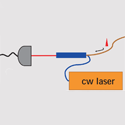

In quantum physics, a particle can occupy separate states at the same time, but once measured—or disturbed by the environment—it must choose a particular state in which to reside. The dynamics of this process, called decoherence, has been extensively studied over the years. Recently, physicists have investigated a process reminiscent of this phenomenon, not for a quantum state but for a measurement apparatus. A new experiment reported in Physical Review Letters has quantified how robust the quantum nature of detectors is.
Physicists have been able to characterize the quantum behavior of different photon counters by observing the detector response to a variety of photon inputs. When this data is mapped to a kind of probability distribution, some of the probabilities turn up negative, which is a telltale quantum signature.
Virginia D’Auria and her colleagues at the Kastler Brossel Laboratory in Paris, France, wanted to test the quantum limits of such photon detectors. To follow this process and observe the transition of the device from the quantum to the classical world, the researchers applied varying levels of noise to the detector. They showed that the characteristic negative probability values disappeared when the noise increased to roughly half the detector’s efficiency. – Michael Schirber