




Imaging with Zero Photons
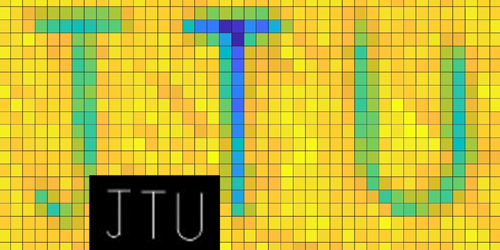

Split a beam of light in two and direct one beam (the reference) to a multipixel camera and the other (the signal) to an object to be imaged and to a single-pixel detector beyond it. Measuring correlations between photon arrival times at the two detectors enables the object to be imaged by the camera despite the reference beam not interacting with the object. Now Meixue Chen at Xi’an Jiaotong University in China and her colleagues have demonstrated an even stranger version of this technique: They construct an image by discarding every signal-beam photon that interacts with the object [1].
Ghost imaging relies on coincident detections: A signal photon’s trajectory, which embodies imaging information, is inferred from location information that the camera acquires from a correlated reference photon. Such correlations can arise from quantum entanglement or classical fluctuations. Chen and colleagues used so-called pseudothermal light generated by passing a low-intensity laser through a rotating, roughened glass disc before it reached the beam splitter. This disc shifted the phase of the light randomly across the beam’s wave front. Interference between different parts of the wave front then created fluctuations in intensity, or photon number, that persisted after the beam was split in two.
The researchers sent both beams to single-pixel detectors—the signal beam via the object to be imaged and the reference beam directly to a detector, which was rastered back and forth to capture spatial information. They assembled an image of the object—the initials of their institution—despite retaining only the reference-photon detection. What’s more, they showed that an image could be formed using time windows when zero photons were detected from both beams. Chen says that such “zero-photon” imaging could be useful in medical imaging or other applications requiring low levels of illumination.
–Marric Stephens
Marric Stephens is a Corresponding Editor for Physics Magazine based in Bristol, UK
References
- M. Chen et al., “Ghost imaging with zero photons,” Phys. Rev. A 114, 043723 (2026).