




Gluons Chip in for Proton Spin
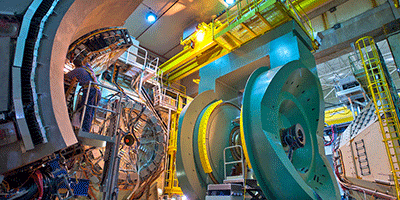

The proton has a spin that comes from its constituent quarks and gluons. Experiments in the 1980s found—unexpectedly—that the contribution from the intrinsic spins of the quarks was small. This so-called “proton spin crisis” remains unresolved, but a new comprehensive analysis of proton scattering data, reported in Physical Review Letters, finds the first clear evidence that the gluon spin polarization is not zero, suggesting that gluons may have a significant role in the spin of the proton.
The proton is a spin 1/2 particle made up of three quarks held together by gluons that carry the strong force. The quarks have spin 1/2, so physicists originally assumed that two of the quarks were in opposite alignment (cancelling their spin), leaving one unpaired quark to give the proton spin. However, measurements of muon-proton collisions found only a quarter of the proton’s spin comes from quark spins. The rest has to come from gluon spins and/or the orbital motion of quarks and gluons inside the proton.
To determine the contribution from gluons, which have spin 1, physicists measure the probability that a gluon with a particular momentum is aligned, or polarized, with respect to the proton spin. Earlier observations of proton-proton collisions at the Relativistic Heavy Ion Collider (RHIC) found the gluon polarization was close to zero for moderate momenta values. However, using more recent RHIC results, Daniel de Florian of the University of Buenos Aires, Argentina, and his colleagues find a nonzero gluon polarization. More data is still needed at low momentum, but the current best fit suggests that as much as half of the proton’s spin comes from gluon spins. — Michael Schirber