




Lasers light up some magnetic moments
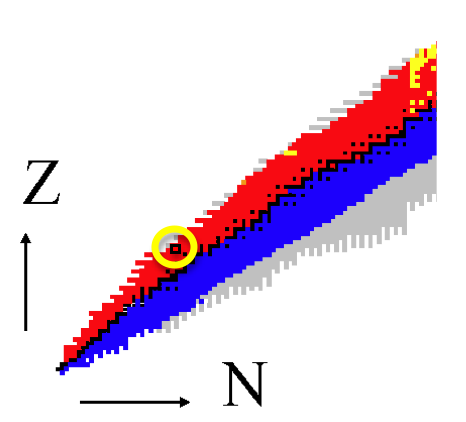

Measuring the magnetic moments of nuclei far from stability offers a unique way to test our understanding of nuclear structure. In a paper appearing in Physical Review Letters, Thomas Cocolios and colleagues at Katholieke Universiteit Leuven in Belgium present a new method to perform laser spectroscopy of exotic species that are only produced in small quantities. They demonstrate the effectiveness of the technique by measuring the hyperfine structure of the radioactive nuclei and to deduce their magnetic moments. The moment, in particular, is of great interest because it can be modeled as a single proton outside of the presumed doubly magic, , core.
Cocolios et al.’s result is consistent with this configuration and resolves a puzzle raised by a previous measurement that could only be understood if were not a good doubly closed shell nucleus. Their new technique of resonant laser ionization with subsequent mass separation of the ions represents a milestone for laser spectroscopy of short-lived radionuclides, and has promise for future improvement by the addition of an ion trap. The exquisite sensitivity of this new method will probably have further applications, for example, in trace element analysis. – Gene D. Sprouse