




The long and short of it
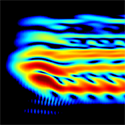

As laser pulses get shorter and shorter, physicists are able to study the internal dynamics of a molecule with a level of detail far beyond previous expectations. The advent of attosecond laser physics has enabled researchers to accurately create an electronic or vibrational excitation in molecules, which may then be tracked by other optical pulses as the excitation evolves. So far, however, it has turned out to be a challenge to prepare reproducible attosecond wave packets in molecules with sufficient signal above the noise. In addition, the high fields used for the probe laser often tend to perturb the system, which hampers a correct analysis of the results.
In their report in Physical Review Letters, Freek Kelkensberg and colleagues at the FOM Institute for Atomic and Molecular Physics in Amsterdam, The Netherlands, and collaborators in Canada and Europe demonstrate a method that solves both these problems. Using state-of-the-art 400-attosecond XUV pulses, the authors ionize hydrogen molecules and launch a vibrational wave packet in the resulting molecular ion. The ultrafast dynamics of these wave packets are subsequently probed by intense femtosecond infrared pulses. For longer pulses the wave packets propagate adiabatically, whereas for shorter pulses the creation, dephasing, and revival of vibrational wave packets is observed. These results show the importance of pulse duration in the analysis of strong field molecular dynamics and reveal the onset of adiabaticity in the dissociative ionization of molecular hydrogen, leading to a detailed understanding of the elementary bond-breaking process in molecules. – Deniz van Heijnsbergen