




3D Dirac Plasmons

Plasmons—quantized collective oscillations of electrons found in conventional metals and semiconductors—are attracting interest for applications in sensing, fast electronics, and solar cell technology. Plasmons can also exist in exotic solids known as Dirac materials. Dirac plasmons present many advantages over conventional ones, such as a higher propagation velocity and frequency tunability. Dirac plasmons have so far been observed in 2D materials like graphene. However, 2D plasmons are extremely sensitive to the presence of defects and contaminants on the material’s surface. Now, Antonio Politano, from the Italian Institute of Technology–Graphene Labs in Genoa, and colleagues have provided direct evidence of 3D Dirac plasmons in the bulk of platinum ditelluride ( ).
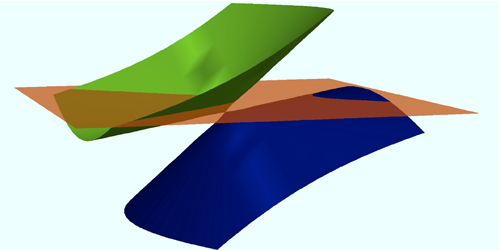
Recent research showed that is a 3D type-II Dirac semimetal, a quantum solid sometimes viewed as a “3D graphene.” The team characterized the material’s electronic excitation with high-resolution electron-energy-loss spectroscopy and interpreted the data by comparing them with density-functional-theory predictions. The analysis revealed electronic quasiparticles collectively moving in energy bands with the anisotropic tilted cones characteristic of a type-II Dirac semimetal. These features allowed the team to conclude that these quasiparticles are 3D Dirac plasmons.
The robustness of these 3D plasmons could be harnessed to realize plasmon-based nanodevices like photodetectors. The researchers envision that, since the material is easily cleaved, such devices could be built using thin layers. What’s more, the data showed that the plasmons could be excited with an energy of about 0.5 eV, corresponding to a wavelength of about 2.4 m. This property could enable optoelectronic applications in which plasmons are controlled with near-infrared laser light.
This research is published in Physical Review Letters.
–Maria Longobardi
Maria Longobardi is a freelance writer based in Geneva, Switzerland.