




The Microscopic Dynamics of Biomolecular Condensates
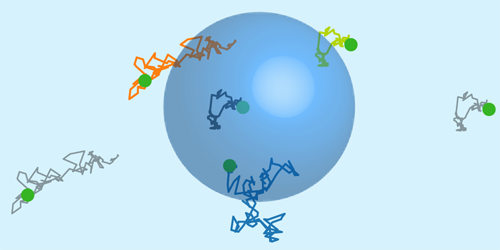

Many of a biological cell’s chemical processes occur within specialized structures called organelles, which are defined by semipermeable membranes. But there is growing evidence that chemical processes can also take place within so-called biomolecular condensates—membraneless regions of cytoplasm enriched in a particular biomolecule by a spontaneous phase-separation process. Stefano Bo and colleagues at the Max Planck Institute for the Physics of Complex Systems, Germany, have now derived an equation that describes the dynamics of individual molecules in these condensates [1]. Combined with cutting-edge microscopy techniques, their analysis could let researchers infer the properties of biomolecular condensates by tracking the trajectories of single molecules.
Phase separation in a liquid is familiar to anyone who has observed oil and vinegar de-mixing in a vinaigrette. Most of the properties of phase-separating systems can be explained by their overall thermodynamics: Similar molecules coalesce in order to minimize the system’s energy. Bo and his colleagues start from this well-established theory and work out what it means for the trajectories of individual molecules in a mixture.
They find that the path of a single molecule through a fluid is determined by the interactions between that molecule and other similar molecules nearby. The resulting path resembles that of a molecule undergoing Brownian motion but with a drift resulting from concentration gradients. The researchers also find that, while the processes of leaving and entering a condensate are asymmetric because of such concentration gradients, at thermodynamic equilibrium, the number and length of trajectories that cross the condensate’s boundary are the same in both directions. The researchers say that this so-called microscopic reversibility has direct implications for the interpretation of current experiments.
–Marric Stephens
Marric Stephens is a Corresponding Editor for Physics Magazine based in Bristol, UK.
References
- S. Bo et al., “Stochastic dynamics of single molecules across phase boundaries,” Phys. Rev. Research 3, 043150 (2021).