




A Tweet-Packed Day for Poster Presenters


Most of the time my Twitter feed is filled with links to science stories or memes of cats. But for 24 hours last week, it was flooded with posters—specifically ones reporting the results of chemistry studies—which had been uploaded by participants in the 2022 #RSCPoster Twitter Conference. This Royal Society of Chemistry event, now in its seventh year, brings together chemistry researchers from around the globe so that they can share their work without the costs—environmental, financial, and time—of a traditional conference. This year, 900 presenters from 69 countries, spread across five continents, registered to share their posters over the course of one day and one night. The attendees say that they joined for social reasons—to interact with friends and colleagues that they haven’t been able to meet in person for two years.
Among the first to connect was Luis Fernando Pérez-Vega, who submitted his poster at exactly 12 pm Coordinated Universal Time (7 am EST)—the launch time of the conference. Pérez-Vega was discussing, from Mexico, his master’s thesis on identifying novel sugar molecules in agave plants. Not only did he have to arrive at work before 7 am (his time) to join the event, but he was also commencing the first day of his Ph.D. project. Pérez-Vega, who has the Twitter handle @Zulref, says that he was inspired to take part both to share his work and to see what others are working on. “The event is a great opportunity to network and find possible collaborations,” he says.
Compared to a traditional poster session, networking was, in some ways, easier in the Twitter conference. Anyone wanting to view the posters only had to put in the hashtag #RSCPoster and then scroll down to view the entire gallery. The 24-hour duration of the session was chosen so that researchers in all time zones could participate in the event during their normal waking hours.
The chance to interact virtually was such a draw that some researchers became Twitter members just to participate in this conference. Geoffrey Weal (@GeoffreyWeal) is one such person. He tuned in from New Zealand from a newly created Twitter account to share his poster on producing carbon-neutral fuels with copper nanoparticles. He says that the way that the event was organized made it easy for him to participate, despite the fact that it was night for him, while it was day for most of the other attendees—and vice versa. “I am not much of a social media person,” he says. “But I see how Twitter is a very powerful and ... positive tool for learning about cool research and amazing researchers from every part of the globe.”
Julie Phillips (@julieindiana) also tuned in from the Southern Hemisphere, joining from Australia to present her work on understanding the electrochemistry of a type of metal-oxide anion. She stayed up past 1 am her time to respond to questions and to chat with other researchers. “I want to get out there a bit more,” she says. “I thought this [event] was a great way to do that.”
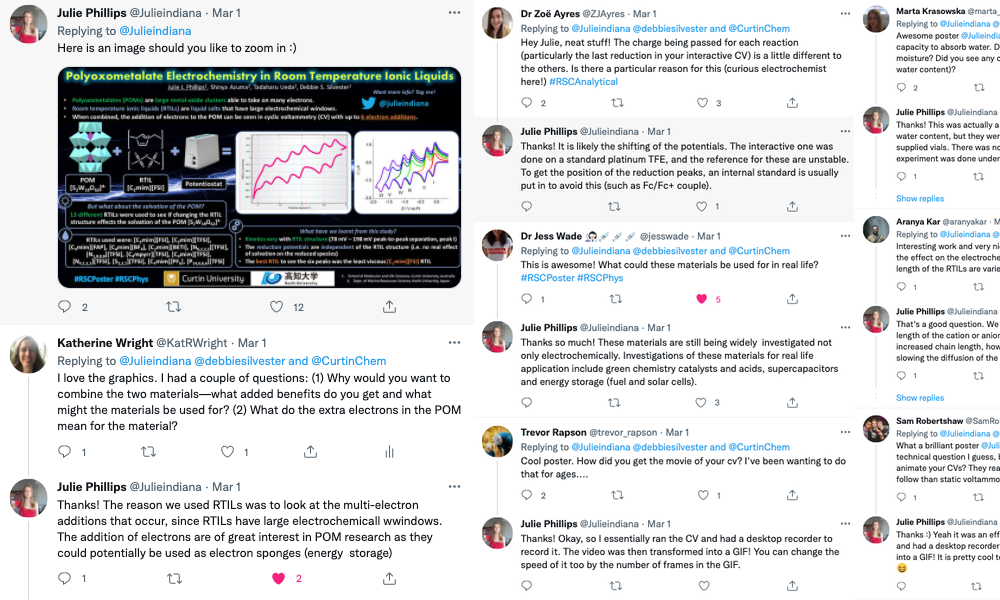
Phillips also had some fun when making her poster, incorporating into it two animated elements—a twirling molecule and a self-drawing graph. Cartoons and videos also appeared in posters, with researchers leveraging the conference’s virtual platform to bring their work alive. For example, Samanta Camalhonte (@atnamassss) and Camila Fonseca (@camilavegana) created a one-minute-long animated film that discussed their work on developing antiviral medications for COVID-19. The film parodies the storyline of the science-fiction film Back to the Future and shows that scientists don’t need to go back to the past to have an impact on fighting the pandemic. Fonseca, who tuned in from Brazil, says that she picked this theme because “I thought it would symbolize hope for different and better realities in a light way.”
Fonseca also attended last year’s #RSCPoster Twitter Conference and was one of many repeat participants. Another was Manon Rolland (@manonrolland19), who was tweeting from Switzerland. Rolland presented her work on controlling the shape of particles in a nanoemulsion. As to why she took part, Rolland says that “the Twitter conference is my favorite time of the year. [It’s] such a nice way to share and discover science through a different perspective.”
–Katherine Wright
Katherine Wright is the Deputy Editor of Physics Magazine.