




Snapshot: New Company for Pluto?
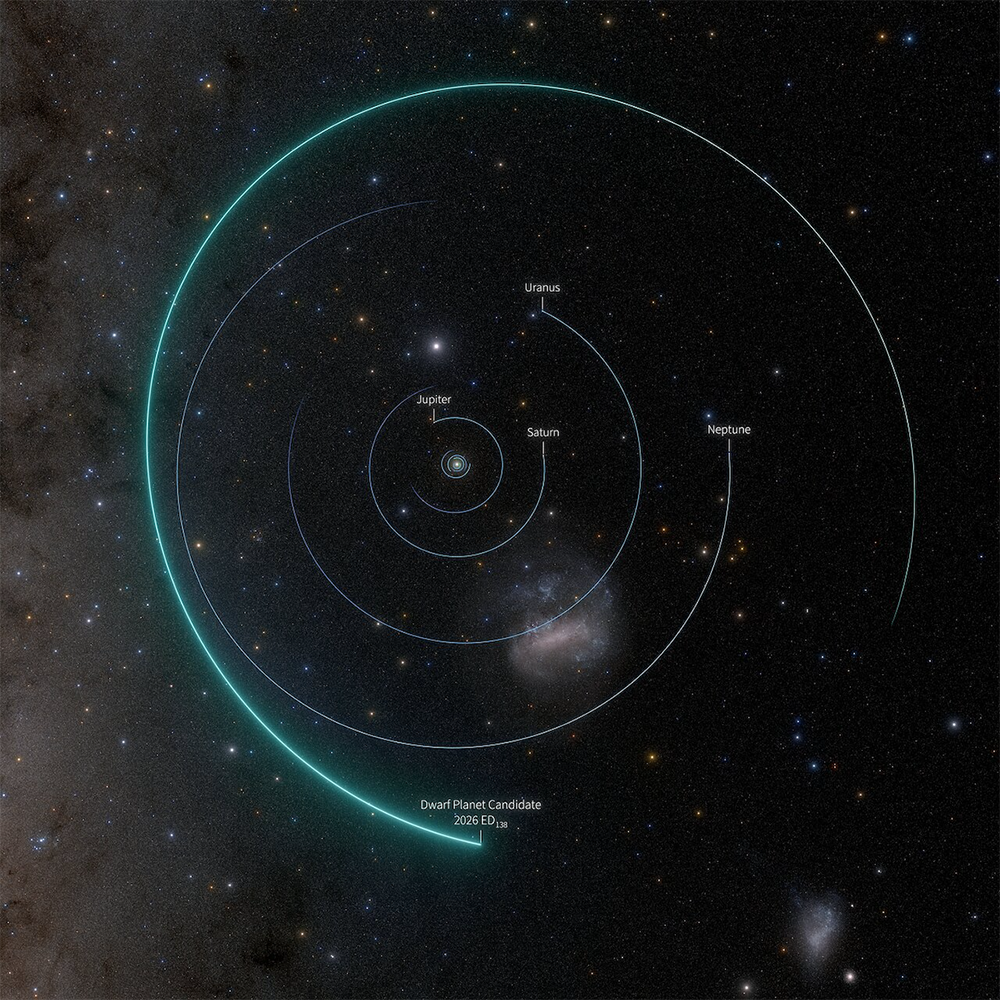

The Vera C. Rubin Observatory in Chile has likely spotted a distant dwarf planet, potentially adding to the small family of similar objects in the Solar System. A dwarf planet is massive enough for its own gravity to mold it into a round shape but—unlike a full-fledged planet—not massive enough to clear its orbital neighborhood by accreting or ejecting other objects. Pluto, for instance, shares its orbit with thousands of icy bodies. Equipped with the world’s largest camera, Rubin has an unmatched ability to track moving or changing objects in the sky. In just four months, it has already detected more than 10,000 asteroids, as well as supernovae and variable stars (See Research News: Launching an Alert System for the Changing Sky). On October 13, as they were analyzing data collected in early 2026, researchers with Rubin’s Solar System Science Collaboration found the bright and unusually large object, with an estimated diameter between 600 and 1500 km. The candidate dwarf planet, provisionally dubbed 2026 ED138, is currently located at a distance from the Sun that is 46 times the Earth–Sun distance. If follow-up observations confirm the dwarf-planet designation, it would join the five others that are officially recognized by the International Astronomical Union: Pluto, Ceres, Eris, Haumea, and Makemake.
Snapshot articles highlight eye-catching images from across physics.
—M.R.