




A Half Century of Possible Solutions to the Information Paradox
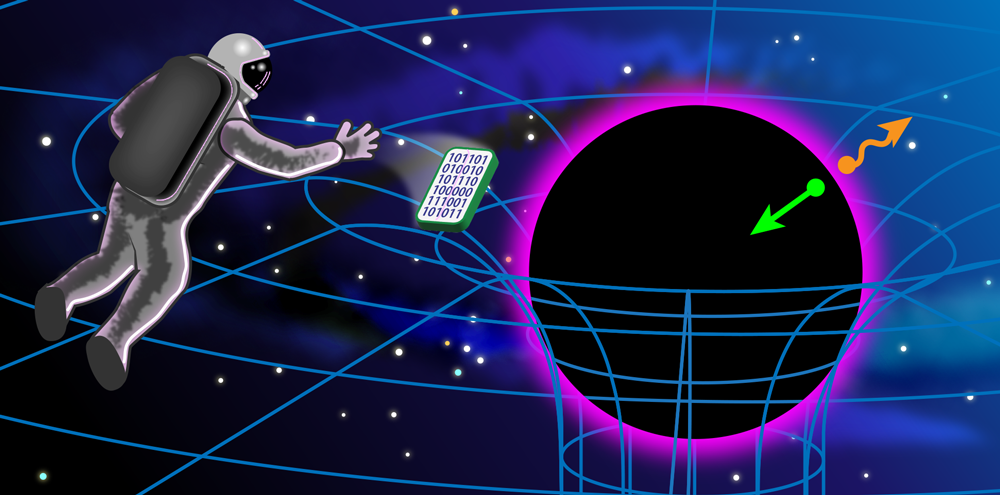

This article is part of a series that Physics Magazine is publishing to mark the 50th anniversary of Hawking’s formulation of the information-loss paradox. See also Special Features: Hawking’s Black Hole Paradox Exposed Clash Between Physics Theories and The Art of Asking Questions: From Stephen Hawking to AI.
Stephen Hawking loved to make bets. One of his most famous was a wager made in 1997 with Kip Thorne and John Preskill (both at Caltech) on what happens to information entering a black hole. Hawking bet that the information is lost forever—prevented by the rules of general relativity from ever escaping. Thorne sided with Hawking, while Preskill took the opposing side, upholding the principle of quantum mechanics that says information can never be truly destroyed.
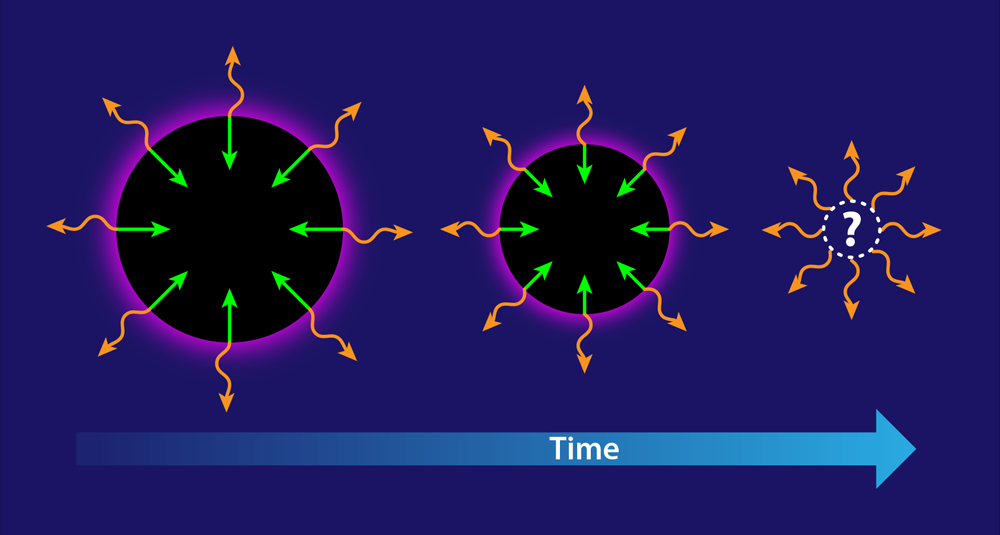
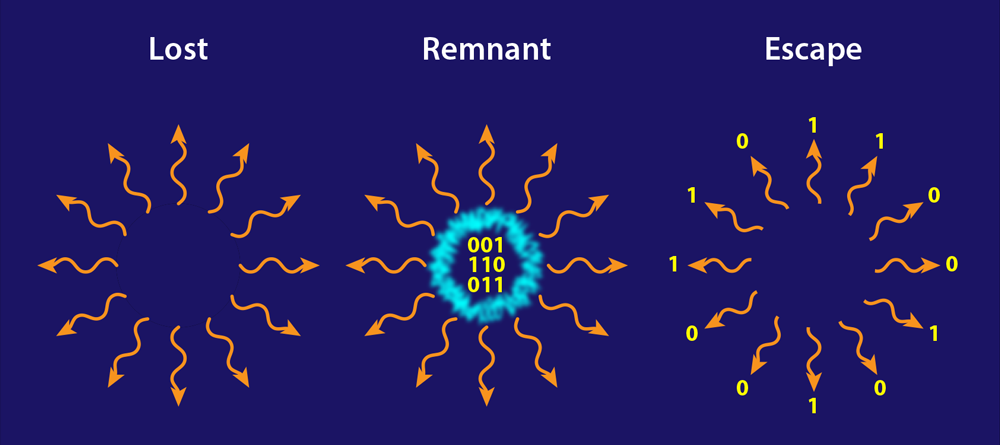
This debate, referred to as the black hole information paradox, had its origin in a 1976 paper [1], where Hawking pointed out a problematic implication of black hole radiation—an idea that he had proposed two years earlier. According to that idea, a black hole will continuously emit thermal radiation, losing mass as it does. Eventually, the black hole will evaporate completely. Hawking realized a problem with this: The “stuff” that went into creating the black hole carried information about the states of all the particles it contained. In the picture of black holes imposed by general relativity, this information can never get back out of the black hole—and so when the black hole vanishes from the Universe, so does all that information. This disappearance conflicts with a basic principle of quantum mechanics, called unitarity, which insists that information is never lost.
Hawking originally thought that relativity wins out. But he ended up conceding defeat in 2004, giving Preskill the wagered prize: an encyclopedia of baseball. It was never clear, though, that his change of heart was based on any compelling scientific argument—it seemed more of a hunch. So even after Hawking’s concession, the issue wasn’t considered to have been definitively settled, and the paradox remains debated today. Yet the quest for a resolution has proved tremendously fertile, illuminating new connections between general relativity, quantum mechanics, information theory, and thermodynamics.
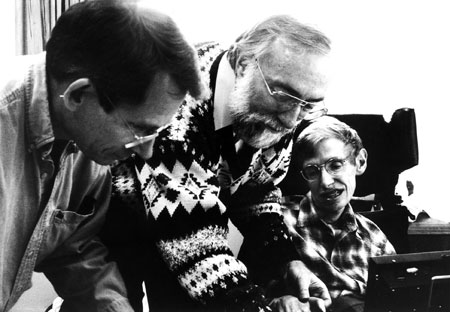
“The black hole information paradox has been a huge driver for research in quantum gravity for 50 years,” says Marika Taylor, a theoretical physicist at University College London and Hawking’s PhD student in the 1990s. She calls the paradox a “key testing ground” for theorists. “Any putative theory of quantum gravity has to provide answers for the quantum behavior of black holes,” she says.
“Information loss was one of the key questions for Stephen throughout the late 80s and 90s and until the very end of his career,” Taylor adds. According to another former student, Don Page, now a theoretical physicist at the University of Alberta in Canada, the paradox created something of a disciplinary schism in physics from the 1980s onward. Particle physicists, immersed in quantum theory, tended to believe that information was preserved, while experts in general relativity tended to agree with Hawking’s original proposal that information is destroyed. (Page himself deviated from Hawking’s view in 1980 when he argued that black holes should release their information [2].)
Many suspect there will be no definitive answer until we have cracked the problem at the heart of the matter: how to reconcile quantum mechanics with general relativity. “I think some version of the information problem will definitely exist until we have at least one very well-defined and complete theory of quantum gravity, and potentially even beyond that,” says quantum-gravity physicist Geoff Penington of Stanford University in California.
Holography and Hawking’s Soft Hair
Hawking’s original argument was that quantum mechanics fails inside a black hole, so that information is lost for good (see Special Feature: Hawking’s Black Hole Paradox Exposed Clash Between Physics Theories). But he made assumptions in his 1976 paper that may not be valid in the extreme situation of a gravitational singularity, where the matter density becomes infinite and the known laws of physics break down. “Even Hawking would have said his calculation can’t be trusted,” Penington says.
The information paradox languished until the 1990s, when several theoretical innovations revitalized interest in it. Hawking himself decided he was wrong because of work by theoretical physicist Juan Maldacena—now at the Institute for Advanced Study (IAS) in New Jersey—suggesting a way to think about general relativity in quantum terms. In 1997, Maldacena argued that the general-relativistic description of 3D space is mathematically equivalent to a quantum field theory operating within the 2D boundary of the space. In other words, spacetime appears as a kind of holographic projection on the boundary.
This holographic picture is not a direct reflection of our reality: The 3D space has a hypothetical, saddle-shaped geometry, called anti-de Sitter (AdS), and the 2D quantum theory is a generic model, called conformal field theory (CFT). Nevertheless, the AdS/CFT correspondence implies that information can’t be lost in a 3D space containing a black hole, as the quantum description on the 2D boundary must remain unitary. This line of reasoning “is what convinced Stephen that he was wrong about the information paradox,” says astrophysicist Bernard Carr of Queen Mary University of London, who was Hawking’s PhD student at the University of Cambridge in the UK in the early 1970s.
In 2004, Hawking announced that he and his student Christophe Galfard had finally cracked the problem, outlining his reasoning at a conference in Dublin. Because Hawking had given prior notice of intent to the press, the auditorium where he presented his findings was filled with journalists in the front-row seats. The lecture was reported all around the world—but few experts were impressed by the work, which was regarded as more puzzling than clarifying. “His reasoning wasn’t entirely clear to colleagues,” Taylor says. “It had all been a tad performative,” admits Graham Farmelo, author of a recent biography on Hawking [3].
Tacitly acknowledging that he hadn’t sealed the argument, Hawking continued to work away at the problem up until his death in 2018. With his students Malcolm Perry and Andy Strominger, he began a different approach to the AdS/CFT idea. In 2016, these researchers argued against the so-called no-hair conjecture, which states that a black hole is characterized only by mass, charge, and angular momentum—leaving its event horizon smooth and featureless. Hawking and his colleagues asserted that a black hole’s horizon may in fact have some structure, which they called “soft hair” [4]. This horizon structure could presumably retain some of the information falling into a black hole (see Viewpoint: Black Holes Have Soft Quantum Hair).
The soft-hair idea “doesn’t completely resolve the information paradox,” Carr says, “but it’s certainly a way of showing how the information can be contained.” Over the years, researchers have proposed a variety of ways to retain black hole information, he says.
One such information-retaining scenario is a long-lasting black hole remnant. “We can try to bypass the [information paradox] by postulating that some (hitherto unknown) quantum-gravity effects stop the evaporation,” says theoretical physicist Samir Mathur of Ohio State University. If evaporation ceases before the black hole disappears, then the leftover object could hold onto the information that went into the black hole. This remaining object would presumably be tiny, roughly the size of the Planck scale (10−35 m).
The Paradox Gets Entangled
Another option for retaining black hole information is to imagine that it somehow escapes through the black hole radiation (now called Hawking radiation). This escape would require that the radiation not be completely random but instead have information imprinted within it.
Page supplied a key insight for this strategy in 1993 [5]. Hawking radiation is generated when two virtual particles pop out of the quantum vacuum as a pair and one particle flies outward, while the other falls into the black hole. Page pointed out that the pair production process creates quantum entanglement between the radiated particle and the trapped particle, so that their properties are correlated. As a result, the radiation very far from the black hole remains entangled with the hole itself, resulting in a quantity called the entanglement entropy.
Page argued that the entanglement entropy between the black hole and its radiation begins at zero (when the hole forms and begins radiating) and ends at zero (when the hole has evaporated). In between those times, it rises, reaches a maximum at roughly half the black hole’s lifetime, and then declines to zero when the black hole dies. This so-called Page curve looks like an inverted V.
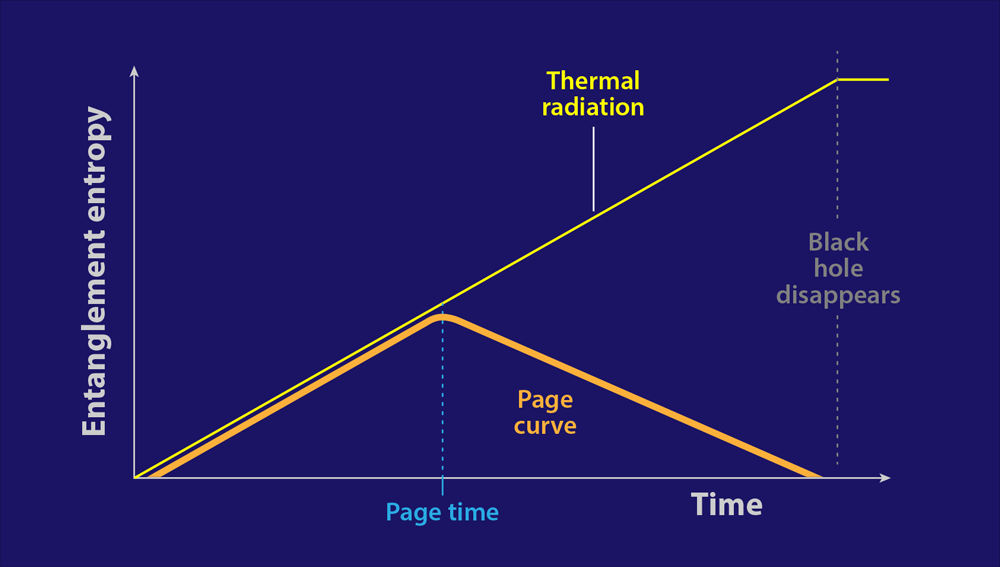
The entanglement between the black hole and the radiation seemed to offer a way for information to get out: It can be encoded in the quantum correlations. If we just look at the radiation, it seems random. But if we could compare it with the state of the black hole, we’d find a nonrandom pattern that encodes the infalling information.
Page’s entanglement picture changed the whole debate, but it didn’t by itself resolve the information paradox. While the argument for the Page curve seemed plausible, it was qualitative. To make it stick, one would need to actually calculate the entanglement entropy—and that was hard. “Page was making clear what the answers probably should be, even if we didn’t know how to get to them,” Penington says.
One possible explanation for the Page curve, developed by Mathur and others, is that stellar collapse doesn’t create a singularity surrounded by an event horizon at all. According to string-theory calculations, what forms instead is a horizon-sized bundle of 1D strings and higher-dimensional objects called branes: a so-called fuzzball, which preserves the information in its interior states [6].
“The fuzzball would radiate from its surface like a normal body, not by pair creation from the vacuum around a horizon,” Mathur says. All the particles in a fuzzball start out entangled, so each particle that radiates away is—at least initially—entangled with a partner left behind in the fuzzball. As a result, the entanglement entropy rises between the fuzzball and its radiation. But around the halfway mark in the fuzzball’s lifetime, the entangled partners start to be emitted too, and the entanglement begins to fall—reproducing the shape of the Page curve, Mathur says.
The End of Locality?
Physicists have come up with other ways to explain the Page curve. Many of these ideas—inspired by Maldacena’s AdS/CFT conjecture—involve tying the radiation outside the black hole to the material inside the black hole [7]. Such a connection between the interior and the radiation would violate the assumption that the physical world is local, in the sense that there can be no faster-than-light influence passing from one place to another.
Locality is a fundamental principle, but it’s one that physicists have struggled with before, in the context of quantum mechanics. Quantum entanglement—the phenomenon in which two distant objects exhibit correlations in their properties—can be considered as a form of nonlocality that connects two apparently spatially separated objects. But MIT physicist Daniel Harlow stresses that black hole nonlocality goes beyond such quantum nonlocality. The nonlocal behavior that Harlow and other researchers are considering is more dramatic: a breakdown of the picture of causality described by special relativity. In this picture, a particle outside a black hole can instantaneously influence another particle residing deep within the black hole, past the event horizon.
This approach to the information problem has developed from work by two teams: an “East Coast” team consisting of Netta Engelhardt of MIT, Ahmed Almheiri, then at IAS, and their colleagues [8]; and a “West Coast” team made up of Penington and his collaborators [9]. These researchers showed that, contrary to what was commonly thought, it is possible to calculate the Page curve even without a complete theory of quantum gravity.
The teams assume that locality applies almost everywhere, but it may fail in situations that involve a high degree of complexity, like the interior of a black hole. Within such complexity, it would become possible to change the spacetime inside a black hole by performing some very complicated operations on its Hawking radiation—even though, according to general relativity, the radiation and the interior are irrevocably separated.
Those operations, Harlow says, are so complex that completing them would take “some insane amount of time.” But “if you somehow allow for these crazy operations, then you can really pull back the veil around the black hole.” And when you do, you find that the spacetime separating the Hawking radiation from the inside of the black hole “isn’t really there,” Harlow says.
For a more intuitive picture of this scenario, imagine collecting all the Hawking radiation from a black hole and feeding it into a huge quantum computer that simulates what’s going on inside the black hole. That simulation would be a quantum-entangled replica of the black hole and, as such, could be regarded as being connected to the interior of the original black hole through a spacetime wormhole [9, 10]. The existence of such a wormhole implies that information can pass from one side of the event horizon to the other simply by performing some manipulation of the Hawking radiation.
These replica black holes and wormholes are in one sense mathematical entities—but they imply that an event in one location can affect an event in another location instantaneously, violating the prohibition on faster-than-light signaling. For Harlow, this nonlocality implies that spacetime itself is not fundamental but an emergent feature of entanglement. “It’s not [going to be] there in the fundamental equations of quantum gravity,” he says.
So far, the calculations apply only to “toy models” that may or may not be relevant to the real world. All the same, Harlow says, “that’s progress”: It’s better than the situation presented in Hawking’s 1976 paper, which simply said that physicists studying black holes had to abandon unitarity or locality or some other cherished principle. Testing any of these ideas is another matter. “Once you construct the theory, then you can see what it predicts, and maybe some of it will be testable,” Harlow says.
What’s the Problem?
Not everyone agrees that there’s really an information paradox to be explained in the first place. “I’m not impressed by the black hole information paradox,” says cosmologist George Ellis of the University of Cape Town in South Africa, who worked closely with Hawking in the 1970s. For one thing, he says, “information isn’t even defined in these papers.”
Information theorist Chris Adami of Michigan State University agrees, arguing that Hawking made a key mistake in his 1976 paper. “He ignored the contribution of the stimulated emission of radiation that, according to Einstein’s theory of blackbody radiance, must accompany the spontaneous emission (the Hawking radiation),” he says. Once one allows for stimulated emission, he argues, “information is fully recoverable from the radiation outside the black hole horizon” [11].
The information problem might also be part of a broader question: From what perspective should we view a black hole? “You want to compare the experience of an infalling observer with that of an outside observer,” says quantum-information physicist Ladina Haussmann of the Swiss Federal Institute of Technology (ETH) Zurich. She and her colleague Renato Renner have suggested that those two perspectives may give incompatible but individually irrefutable conclusions [12]. This problem of perspectives is similar to a famous paradox in quantum mechanics called Wigner’s friend, in which two observers also seem to reach contradictory views—in that case, about a quantum measurement. For both paradoxes, the trouble seems to arise, Haussman says, when we suppose there is some “God’s-eye view” that encompasses both observers.
Regardless of where the truth lies, perhaps the real virtue of Hawking’s puzzle is its productivity for physics. “All of the exploration of black holes in the context of information loss has led into the modern links with quantum entanglement, reconstruction and emergence of spacetime, the holographic description of gravity, and so on,” Taylor says. “In my mind there is no doubt that this work is completely seminal, strongly shaping the field over decades.”
–Philip Ball
Philip Ball is a freelance science writer in London. His next book, The Man Who Broke Reality, a biography of Niels Bohr, will be published in December.
References
- S. W. Hawking, “Breakdown of predictability in gravitational collapse,” Phys. Rev. D 14, 2460 (1976).
- D. N. Page, “Is black-hole evaporation predictable?” Phys. Rev. Lett. 44, 301 (1980).
- G. Farmelo, Hawking: His Life and Work (Bantam, New York, 2026), p. 404[Amazon][WorldCat].
- S. W. Hawking et al., “Soft hair on black holes,” Phys. Rev. Lett. 116, 231301 (2016).
- D. N. Page, “Information in black hole radiation,” Phys. Rev. Lett. 71, 3743 (1993).
- S. D. Mathur, “The fuzzball proposal for black holes: An elementary review,” Fortschr. Phys. 53, 793 (2005).
- C. Akers et al., “The black hole interior from non-isometric codes and complexity,” arXiv:2207.06536.
- A. Almheiri et al., “Replica wormholes and the entropy of Hawking radiation,” arXiv:1911.12333.
- G. Penington et al., “Replica wormholes and the black hole interior,” arXiv:1911.11977.
- A. Almheiri et al., “Replica wormholes and the entropy of Hawking radiation,” J. High Energy Phys. 2020, 13 (2020).
- K. Brádler and C. Adami, “One-shot decoupling and Page curves from a dynamical model for black hole evaporation,” Phys. Rev. Lett. 116, 101301 (2016).
- L. Hausmann and R. Renner, “The firewall paradox is Wigner’s friend paradox,” arXiv:2504.03835.