




Gravitational-Wave Observations Implicate Failed Supernovae
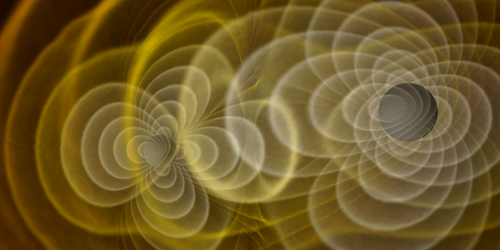

Gravitational-wave observatories have detected signals from more than 200 binary black hole mergers. The observations imply that in more than 75% of merging black hole pairs, the larger of the two is around 10 solar masses, while in hardly any of the pairs is the larger one between 12 and 16 solar masses. But as the larger black hole surpasses 16 solar masses, occurrences pick up. This recovery is puzzling because researchers generally model black hole mass distribution as a modified negative power law, by which the number of black holes sharply increases above a threshold mass before quickly peaking and dropping off according to the power law. Now Isaac Legred of the University of Illinois Urbana-Champaign and colleagues propose that the observed distribution could arise from the failure of certain stars to go supernova [1].
Legred and colleagues’ model isolates 10-solar-mass black holes that form from stars of between 12 and 14 solar masses. Owing to the compactness of their cores, these stars directly collapse into black holes without undergoing a supernova. They reliably form black holes of around 10 solar masses, whereas stars with just slightly lower or higher mass that explode shed almost all their mass and form neutron stars. When the researchers add the direct-collapse subpopulation to the remaining population, the combined distribution reproduces the observed dip at 12- to 16-solar-mass black holes—provided the negative power law that describes the remaining population becomes effective at around 16 solar masses. The work motivates further study of 10-solar-mass black holes and poses the question of why the power law would turn on at that threshold.
–Sophia Chen
Sophia Chen is a freelance science writer based in Columbus, Ohio.
References
- I. Legred et al., “Low-mass failed supernovae and the 10 Mpeak in the merging black hole mass distribution,” Phys. Rev. D 114, 103023 (2026).