




Using Pulsars to Probe Early Growth of Black Holes
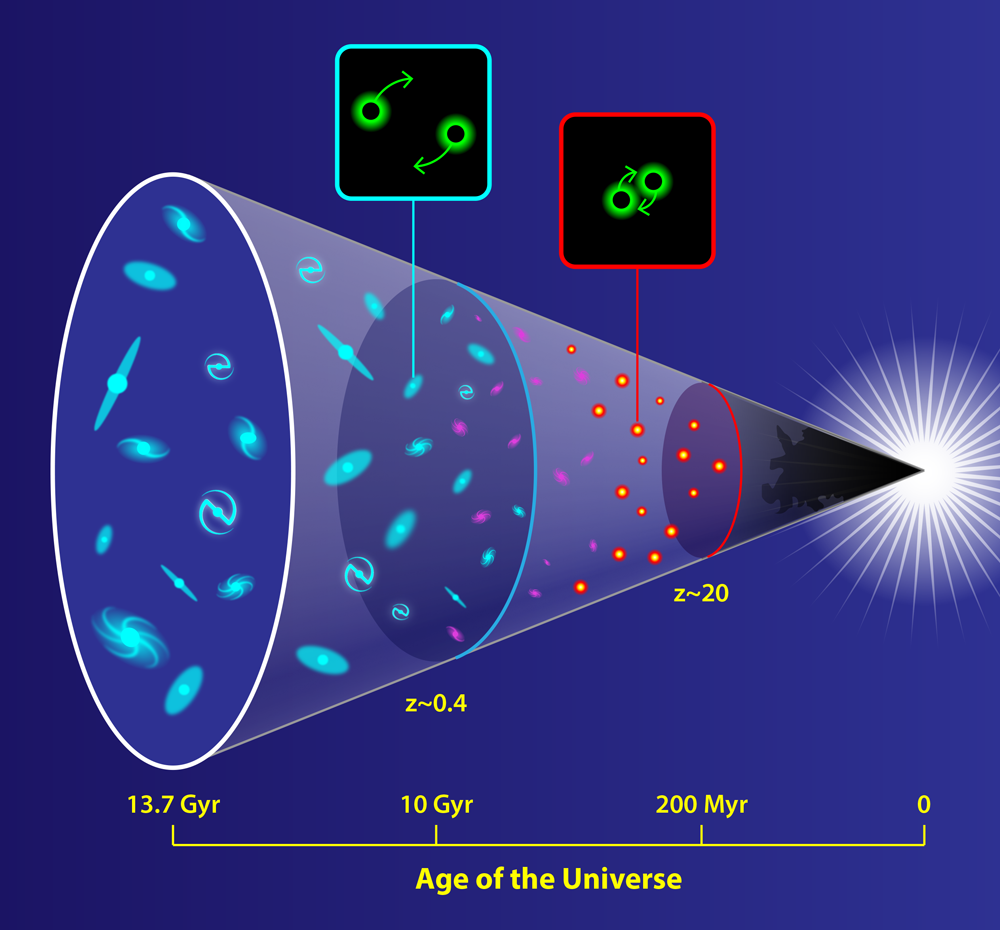

In our lifetimes, an amazing thing has happened: Black holes have advanced from “remarkable inventions of the human mind” [1] to empirical objects studied with telescopes and gravitational-wave detectors. A major puzzle in black hole astronomy is understanding the assembly of “supermassive” black holes—those having masses over a million times that of the Sun. The debate hangs on decades of impressive work but can be summed up simply: Did black holes start massive, grow massive, or build up through mergers? Yiqin Chen from Beijing Normal University and her colleagues have opened up a new way to tackle the problem [2]. They use a long-running experiment called the Parkes Pulsar Timing Array, located in Australia, to probe a possible signal of early-Universe black hole binaries in low-frequency gravitational waves. While this technique is not yet sensitive enough to detect the earliest systems, the researchers have placed the first direct gravitational-wave limits on supermassive black hole growth in this era.
Supermassive black holes have been detected in the centers of many local galaxies, including our own Milky Way [3]. Evidence of earlier black holes extends as far back as the “cosmic dawn”—the era when the first galaxies turned on and the intergalactic gas ionized [4]. In particular, the JWST observatory has recently observed an unexpected abundance of luminous “little red dots” at redshifts around z = 10, corresponding to a cosmic age of about 500 million years (Fig. 1). The nature of these dots is unclear, but some researchers have argued that they are active black holes, whose apparent brightness implies that they are quite massive—as much as 108 times the mass of the Sun [5].
Such large masses, so early, would be at odds with standard paradigms for black hole birth and growth. If the implied masses hold up, one explanation could be that black holes “seed big and feed big”—in other words, they start from massive progenitors and grow rapidly within nuclear star clusters [6]. Massive black holes in sufficiently high abundance might also pair up into binaries [7], whose slow, stable orbits would sluggishly stir their surrounding space-time, producing low-frequency gravitational waves detectable by pulsar timing arrays (PTAs).
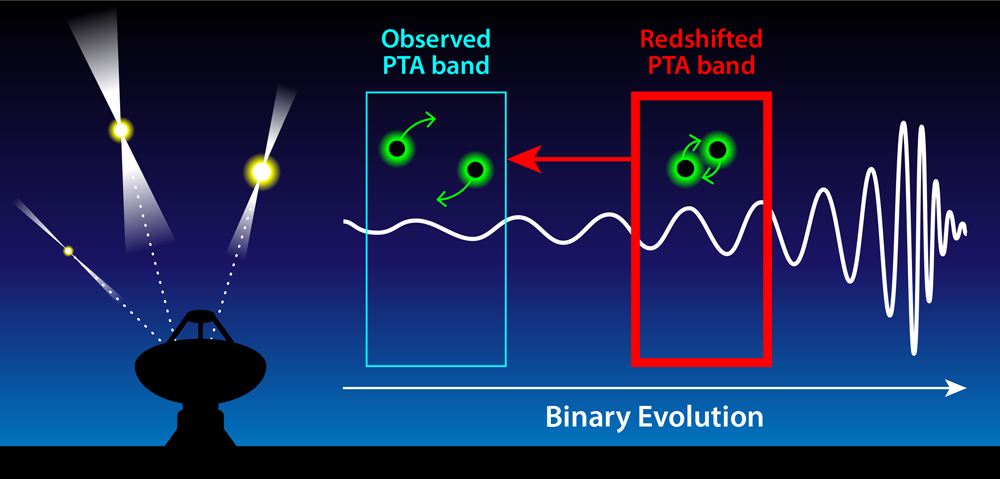
A PTA is a galaxy-sized gravitational-wave detector that uses tens of Milky Way pulsars spread across the sky. Each pulsar is a rotating neutron star that emits radio waves like the beam from a lighthouse. On Earth, we detect those radio waves as a periodic flash. If a gravitational wave passes through the Milky Way, its effect on space-time will induce a change in the perceived rotation rate of the pulsar. To detect this effect, astronomers monitor multiple pulsars, looking for a characteristic pattern of rotational changes that is correlated across the sky. Because PTAs measure their pulsars’ rotation rates every few weeks over decades, they are sensitive to frequencies in the nanohertz range, which corresponds to massive binary systems orbiting each other about once per year or so.
In 2023, several PTA collaborations reported evidence of a diffuse gravitational-wave signal in the nanohertz range (see Research News: Researchers Capture Gravitational-Wave Background with Pulsar “Antennae” and Special Feature: The Nanohertz Gravitational-Wave Detection Explained). This signal is widely believed to be the result of an ensemble of supermassive binaries in the “local” Universe. Here, “local” refers to cosmological redshifts of less than about 2, which corresponds to the last 10 billion years. PTA researchers have tried to isolate the signal of individual binaries detectable above the diffuse gravitational-wave background, but no such signature has yet been seen. On the basis of this nondetection, previous work has set limits on the masses of black hole binaries in the local Universe [8].
Chen and colleagues reformulate traditional PTA searches using a cosmological correction that makes distant sources appear brighter [9]. When we observe a binary source beyond the local Universe, our perception of its orbital frequency is increasingly influenced by the larger redshift. A signal that we see in the PTA wave band originates from a higher frequency (tighter rotational orbit) in the binary’s reference frame. Faster orbits occur later in the binary’s inspiral, when the gravitational-wave emission is stronger (Fig. 2). This intrinsic brightening of redshifted sources can outpace the typical dimming associated with increased distance, making PTAs counterintuitively more sensitive to faraway sources.
The researchers corrected for this “redshift bias”—which earlier works ignored—using data from the Parkes Pulsar Timing Array. By doing this, they determined for the first time the range of binary masses and redshifts that PTAs can target, mapping the sensitivity from the local Universe all the way out to a redshift of 20. To anchor these limits, Chen and colleagues considered the possible gravitational-wave signal from two electromagnetically detected sources of interest in the cosmic-dawn era: The first is a highly luminous quasar (J0100 + 2802), located at z = 6.3 with an estimated black hole mass of 12 billion solar masses; the second is an extremely distant galaxy (JADES-GS-z14-0), located at z = 14.3, one of the farthest galaxies known. The researchers show that the Parkes PTA observations are not sensitive enough to test whether either of these systems is a binary, but the limits come close, reaching within a factor of 2 of the quasar’s estimated mass.
While PTAs cannot currently probe early galaxies, their sensitivity is projected to increase as Parkes and other leading PTAs combine their observations [10]. In addition, future instruments, such as the Square Kilometer Array and the Deep Synoptic Array, should boost the precision of pulsar timing measurements, potentially making the PTA method better at spotting signals of individual binaries.
The work by Chen and colleagues provides the first clear demonstration of the handshake between electromagnetic-wave astronomy and gravitational-wave astronomy in outlining the history of black hole growth. Further effort in this direction could revolutionize our understanding of how the most mysterious objects in the Universe became so massive.
References
- M. A. Abramowicz and P. C. Fragile, “Foundations of black hole accretion disk theory,” Living Rev. Relativ. 16, 1 (2013).
- Y. Chen et al. (PPTA Collaboration), “Nanohertz gravitational-wave constraints on supermassive binary black holes at cosmic dawn,” Phys. Rev. Lett. 137, 191401 (2026).
- A. M. Ghez et al., “Measuring distance and properties of the Milky Way’s central supermassive black hole with stellar orbits,” Astrophys. J. 689, 1044 (2008).
- R. Barkana and A. Loeb, “In the beginning: the first sources of light and the reionization of the universe,” Phys. Rep. 349, 2 (2001).
- J. Matthee et al., “Little red dots: An abundant population of faint active galactic nuclei at z 5 revealed by the EIGER and FRESCO JWST surveys,” Astrophys. J. 963, 129 (2024).
- K. Kritos et al., “Massive black hole assembly in nuclear star clusters,” Phys. Rev. D 108, 8 (2023).
- M. C. Begelman et al., “Massive black hole binaries in active galactic nuclei,” Nature 287, 307 (1980).
- A. Roy et al., “Probing the circumgalactic medium with cosmic microwave background polarization statistical anisotropy,” Astrophys. J. 951, 50 (2023).
- P. A. Rosado et al., “Detectability of gravitational waves from high-redshift binaries,” Phys. Rev. Lett. 116, 101102 (2016).
- M. Falxa et al., “Searching for continuous gravitational waves in the second data release of the International Pulsar Timing Array,” Mon. Not. R. Astron. Soc. 521, 5077 (2023).