




Nobel Prize: Neutrinos from Far, Far Away

8 October 2026: We have replaced our initial short announcement with this full-length Focus story.
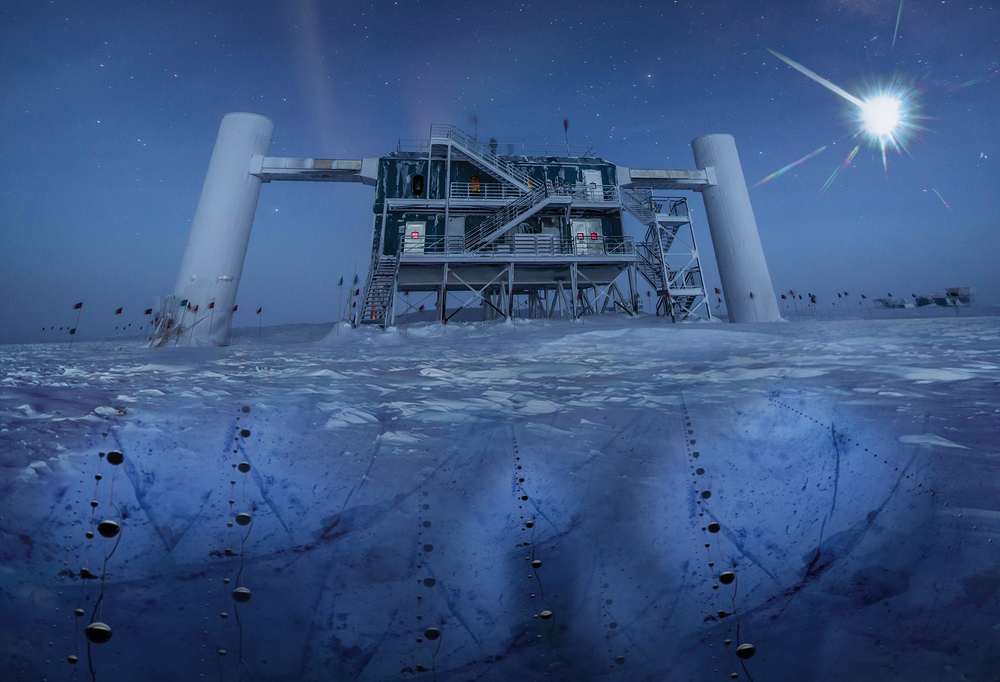
Neutrinos from distant astrophysical sources can reach us without being diverted or absorbed en route. This year’s Nobel Prize in Physics recognizes the potential of neutrino astronomy and the assiduous efforts of Francis Halzen to bring it to fruition. Halzen, a particle physicist from the University of Wisconsin–Madison, was the leading force behind the IceCube Neutrino Observatory—a cubic-kilometer-sized detector operating in Antarctic ice since 2010. Shortly after its construction, Halzen and his colleagues reported the first evidence of high-energy neutrinos originating from cosmic sources [1, 2]. Further study of these astrophysical neutrinos may provide information about the powerful events that produce high-energy cosmic rays.
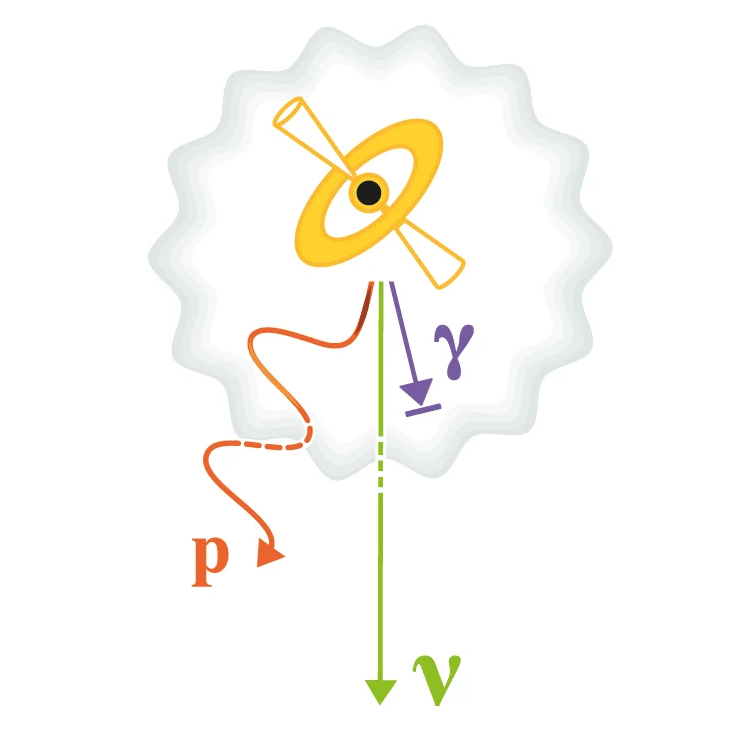
Solar and atmospheric neutrinos (subjects of previous Nobel Prizes) come from nearby, and their energies are in the modest range of MeV–GeV (106–109 eV). But high-energy neutrinos in the TeV–PeV (1012–1015 eV) range are expected from distant sources, such as black hole jets and supernova remnants. Halzen took it as his mission to bring those neutrinos to light.
During the Nobel Prize press conference on Tuesday, Halzen was asked about the challenge of building IceCube. He admitted to being “lucky,” as many people—including Halzen himself—had doubts in the beginning about whether it would succeed.
Early calculations suggested that a kilometer-scale detector would be needed to observe high-energy neutrinos, which are assumed to be produced in the same processes that create cosmic rays. Given the flux of cosmic rays and the likelihood of a neutrino smacking into a nucleus, one could expect 10–100 high-energy neutrino events per year in a 1-gigaton detector, which corresponds to roughly a cubic kilometer [3].
Physicists first considered large bodies of water as neutrino detectors. A neutrino would interact with a water molecule and produce fast-moving secondary particles that would emit light observable by underwater sensors. This strategy was attempted off the coast of Hawaii, but technical difficulties, such as noise from light-emitting marine organisms, led to the project’s abandonment in 1995.
In the late 1980s, Halzen realized that ice might be a better medium than water, as noise is low in the dark, frozen depths. The challenge, of course, is working under perennially icy conditions. Taking advantage of infrastructure at the South Pole, Halzen helped develop the IceCube precursor called the Antarctic Muon And Neutrino Detector Array (AMANDA). That experiment detected lower-energy atmospheric neutrinos while also revealing important technical information, such as the need to go deeper into the ice to avoid light-scattering bubbles.
Halzen obtained funding for IceCube from the National Science Foundation in 2002, and the facility was constructed between 2004 and 2010. The IceCube design resembles a giant ice-fishing expedition, with 86 vertical “lines” of equipment dangling down into the ice. Each line consists of 60 optical sensors at depths between 1.4 and 2.4 km. When a neutrino interacts with a nucleus in the ice, it generates new particles that produce light as they barrel through the ice. The IceCube sensors detect that light, and those data are analyzed to determine the neutrino’s arrival direction and energy.
One of the first major results was the observation of two events (dubbed Bert and Ernie, after the Sesame Street TV characters) that matched expectations for high-energy neutrinos [1]. In their 2013 report, the IceCube Collaboration estimated that each of these neutrinos had over 1 PeV of energy, although uncertainties in the measurements left some doubts (see Synopsis: Energetic Neutrinos on Ice).
Those doubts were largely dispelled a year later when the collaboration reported 37 high-energy neutrino events in the 30-TeV–2-PeV range [2]. The energies and arrival directions confirmed that these neutrinos came from beyond our Solar System (see Viewpoint: The Beginning of Extra-Galactic Neutrino Astronomy). Exactly where these high-energy neutrinos originate, however, is an ongoing mystery, with recent work suggesting possible sources both within our Galaxy and beyond (see Research News: Milky Way Viewed through Neutrinos). With more data from neutrino astronomy, researchers may be able to decipher the mechanisms that accelerate particles to extremely high energies.
“This Nobel Prize in Physics recognizes Francis Halzen’s decades of vision and persistence in making high-energy neutrino astronomy a reality,” says Erin O’Sullivan, the IceCube spokesperson, who is from Uppsala University in Sweden. “What once seemed extraordinarily ambitious is now a new way of observing the Universe.”
IceCube is complemented by other neutrino-astronomy projects, including Baikal-GVD in Siberia and the KM3NeT observatory in the Mediterranean Sea. “Francis Halzen no doubt is a pioneer in the field,” says KM3NeT spokesperson Paul de Jong from Nikhef, the Dutch National Institute for Subatomic Physics, and the University of Amsterdam. De Jong thinks that Halzen had a brilliant idea to use polar ice as a neutrino detector, but he also had the determination to make it happen. “He was no doubt the driving force behind it, making people enthusiastic with his vision.”
–Michael Schirber
Michael Schirber is the Deputy Editor of Physics Magazine.
References
- M. G. Aartsen et al. (IceCube Collaboration), “First observation of PeV-energy neutrinos with IceCube,” Phys. Rev. Lett. 111 (2013).
- M. G. Aartsen et al. (IceCube Collaboration), “Observation of high-energy astrophysical neutrinos in three years of IceCube data,” Phys. Rev. Lett. 113 (2014).
- F. Halzen, “The highest energy neutrinos: First evidence for cosmic origin,” Astron. Nachr. 335, 507 (2014).
More Information
APS announcement of the 2026 Nobel Prize in Physics
2026 Nobel Foundation announcement