




The Surprising Origin of Uranus’ Moons and Rings
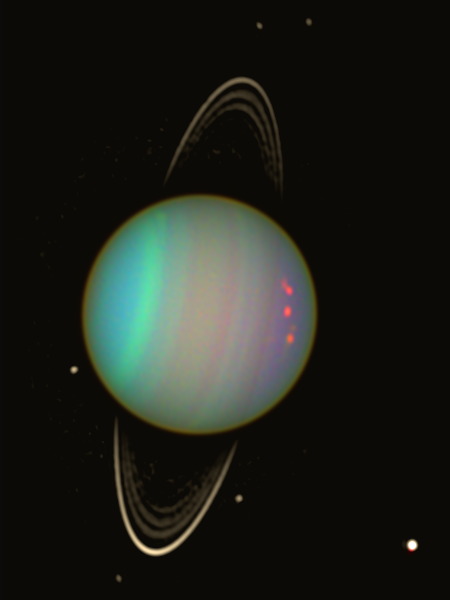

Mercury has a depleted outer mantle. Venus has a retrograde spin. Earth has only one moon. These planetary oddities arose from violent collisions among protoplanets during the Solar System’s giant-impact phase 4.5 billion years ago. Another oddity is the tilted rotation axis of Uranus, which points roughly 90° relative to the planet’s orbital axis. This orientation is shared by most of Uranus’ moon and rings. The common explanation is that Uranus was long ago impacted by a massive protoplanet that tipped the planet over and created a cloud of detritus out of which moons and rings formed (their orientation influenced by the planet’s equatorial bulge). However, that picture now looks incomplete.
Using observations from the James Webb Space Telescope (JWST), Caltech’s Matthew Belyakov and his collaborators have shown that the chemical composition of Uranus’ rings and small inner moons resembles that of Kuiper belt objects (KBOs), rather than that of the larger moons like Miranda or Ariel [1]. Two new scenarios are in the running. Either the Uranus-tilting impactor was a KBO, rather than a protoplanet as was previously presumed, or the protoplanet impactor was followed by a smaller KBO, which, after being broken up by tidal forces, supplied the material for the moon–ring system. But regardless of its origin, the impactor needs to be quite sizeable, something Pluto-sized or above. “What I think this tells us is there were a lot more Plutos originally, possibly in the hundreds,” Belyakov says.
Uranus has five major moons, the largest of which is Miranda. Closer to the planet is a dynamically coupled system of 14 small moons and 9 narrow rings. It’s the most densely packed collection of satellites in the Solar System. Dynamically unstable yet seemingly persistent, this ring–moon system has intrigued astronomers since it was discovered in 1977, nearly 200 years after William Herschel first observed the planet Uranus.
The reason that the ring–moon system took so long to identify is that Uranus is up to a million times brighter than its satellites in visible light. But in JWST’s infrared band, the planet’s brightness is muffled by IR-absorbing methane in its atmosphere, making it easier for Belyakov and his collaborators to study the chemical composition of Uranus’ rings and moons. The cloaking by methane and other chemical compounds species doesn’t fully extend across the wavelength band JWST can detect. But the researchers were able to resolve the moons and ring system and isolate their spectra.
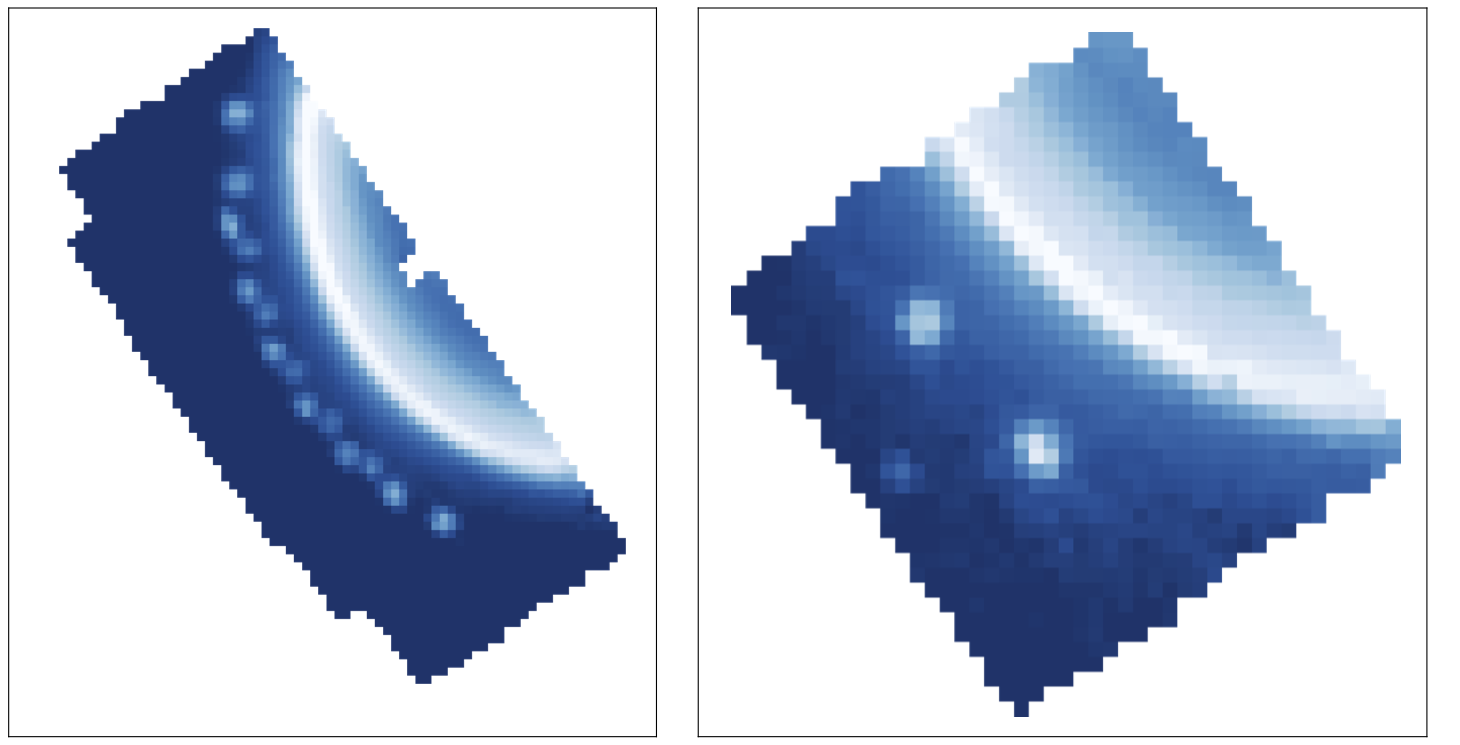
In two pointings in 2025, JWST observed the rings and four inner moons: Juliet, Portia, Perdita, and Puck. Their spectra in the range 1.0–5.0 μm turned out to be remarkably similar. Each features a broad absorption band centered at 3.0 μm and arising from the stretching of the O–H bond in bulk water ice and in dangling hydroxyl groups. Also present in each spectrum (bar Perdita’s, whose signal-to-noise is too low) is an absorption feature arising from frozen carbon dioxide.
The JWST spectra of the Uranian moons and rings resemble those of a new class of KBOs discovered in 2007. Unlike most KBOs, which are reddish in appearance, these new KBOs are bluish, with a spectrum that resembles that of the ice-covered dwarf planet Haumea—implying that they are water-rich. From the new JWST data, Belyakov and his collaborators conclude that the Uranian ring–moon system is made of material from a water-rich KBO. Whether the KBO both caused the tilt and fed the ring–moon system is hard to tell.
But what is clear from other JWST observations is that Uranus’ moons and rings do not resemble Neptune’s, which lack strong spectral signatures of water ice. Planetary scientist Matthew Hedman of the University of Idaho wonders if the two ice giants suffered different disruptions early in their history or if they evolved differently over the past few billion years. “I really don’t know what the answer to this question is at this point, but I’m sure it’s going to be an interesting topic for future research,” he says.
–Charles Day
Charles Day is a Senior Editor for Physics Magazine.
References
- M. Belyakov et al., “JWST Reveals the Kuiper belt-like compositions of the Uranian rings and small moons,” Astrophys. J. Lett. 1010, L18 (2026).