




Snapshot: Galactic Clack Resurrects a Cosmic Note
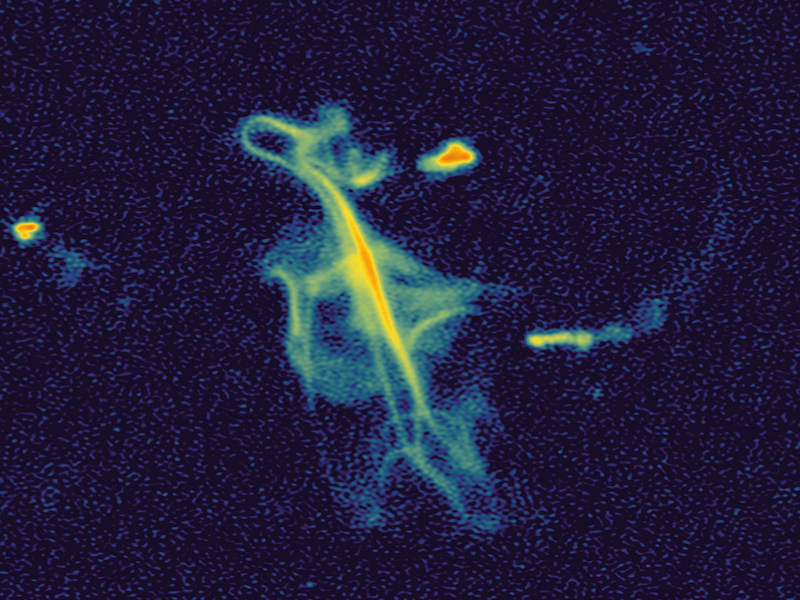

Named after the musical symbol it resembles, the Treble Clef is an example of what astronomers call a radio phoenix. Its characteristic filamentary clouds—extending a million light-years across—originated long ago in relativistic plasma that was shocked and heated by a jet spewing from a supermassive black hole in the center of a galaxy cluster. The plasma would have cooled to invisibility if not for a subsequent merger of the host cluster with a second cluster. The collision compressed, reshaped, and reheated the clouds, restoring their glow. Because radio phoenixes feature spectra that fall steeply at increasing frequencies, observing them requires specialized low-frequency telescopes, such as the Low-Frequency Array (LOFAR), which took the image shown here [1].
Snapshot articles highlight eye-catching images from across physics.
—C.D.
References
- A. Botteon et al., “The Treble Clef radio phoenix and its old nonthermal filaments,” Astron. Astrophys. (to be published) (2026), arXiv:2607.06659.