




Probing Strangeness
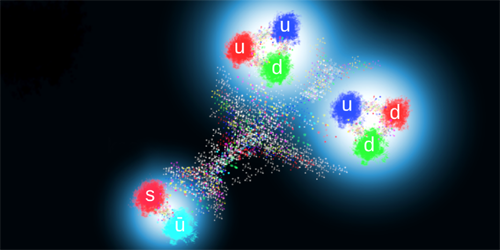

The strange quark is significantly heavier than the up and down quarks and significantly lighter than the charm, top, and bottom quarks. Calculations within quantum chromodynamics (QCD) that are accurate at either end of the quark mass scale are less accurate for the in-between strange quark. To test their methods, theorists need data. Now the ALICE Collaboration has reported the results of studying interactions at the Large Hadron Collider (LHC) between charged kaons (K– and K+), which contain a strange quark and an up quark, and deuterons, which contain a proton and a neutron [1]. The measurements could help improve models of dense baryonic matter, including the interiors of neutron stars, where strange quarks are thought to abound.
In 2015 and 2018, the LHC smashed together lead ions at an energy of 5.02 tera-electron-volts per nucleon pair. Copious kaons are produced in such collisions, but the chances of a kaon and a harder-to-produce deuteron interacting are slim. Of the 337 million lead–lead collisions recorded by ALICE, only a few tens of thousands yielded close encounters between charged kaons and deuterons.
ALICE efficiently combed through those encounters for the even rarer ones in which a K– or K+ passed a deuteron (d) within a few femtometers and with a small relative momentum. At that separation, particles influence each other’s final state via the strong and Coulomb interactions. The ALICE researchers could measure the scattering lengths (a quantum generalization of cross section) for K– + d and K+ + d for the first time. Some models of the kaon–nucleon interaction exploit chirality, a useful approximation for up and down quarks, which are light. The new measurements will help establish the conditions under which those models reach their limits for the heavier strange quarks.
–Charles Day
Charles Day is a Senior Editor for Physics Magazine.
References
- D. A. H. Abdallah et al. (ALICE Collaboration), “First measurement of the strong interaction scattering parameters for the K-d and K+d systems,” Phys. Rev. Lett. 137, 191904 (2026).