




Simulating Particle Creation with Cold Atoms
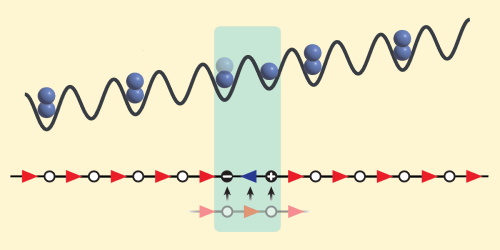

In physics, you can get something from nothing. In a strong electric field, electrons and positrons are expected to pop into existence out of the vacuum. But exploring this so-called Schwinger effect in the lab is impossible because the required field strength (1016 V/cm) is far beyond reach. Now Zi-Hang Zhu from the University of Science and Technology of China and colleagues have simulated the effect of a strong electric field using cold atoms in an optical lattice. The atoms behave as particle physics would predict.
The Schwinger effect is an example of “false-vacuum decay” in quantum field theory. When a strong field prevails, the vacuum state without particles becomes unstable, and the system spontaneously transforms to a lower energy state with particles. These particles are pairs of electrons and positrons in the case of a strong electric field, but other particles and fields can exhibit false-vacuum decay, notably in the early Universe.
In their experiment, Zhu and colleagues placed ten rubidium atoms in a one-dimensional optical lattice. They tuned the potential energy of the lattice to control both the effective electric field and the effective mass of particles coupled to the field. The false-vacuum state was represented by a specific atomic arrangement with two atoms in every other lattice site. Using quantum gas microscopy, the team showed that one atom from a doubly occupied site eventually moves to a neighboring site. The resulting single-occupancy arrangement corresponds to pair creation.
Zhu and colleagues found that the pair-production rate depended on the effective mass and effective field, as expected for false-vacuum decay. In future work, the researchers plan to expand to higher dimensions and explore other quantum field predictions.
–Michael Schirber
Michael Schirber is a Corresponding Editor for Physics Magazine based in Lyon, France.
References
- Z.-H. Zhu et al., “Probing false vacuum decay on a cold-atom gauge-theory quantum simulator,” Phys. Rev. Lett. 137, 141601 (2026).